
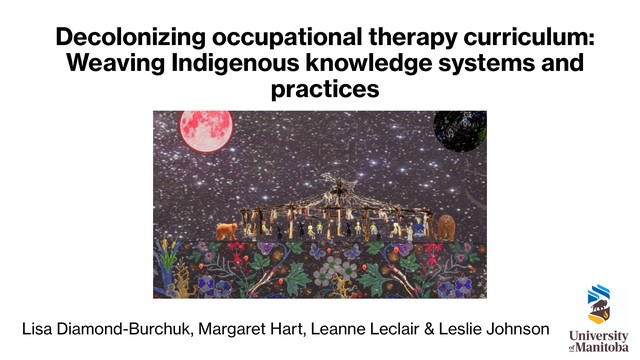
Introduction: A major challenge for Canadian occupational therapy programs, not unlike other colonized countries, is finding ways to address the colonial history between Indigenous peoples and Canadians. Traditionally, post-secondary education has validated its legitimacy through research, scholarly activities, teaching, and learning practices that perpetuate colonial ideology and the hegemonic power of the colonizer. Hence, many institutions are actively engaging in efforts to redesign curricula to reflect and honour Indigenous worldviews, creating new narratives that promote Wahkotowin (relationality and relational accountability).
Objectives: To describe the process used to weave Indigenous Knowledges and Pedagogies that support Wahkotowin throughout the occupational therapy curriculum.
Approach: Through a collaborative process led by an Indigenous Scholar, faculty engaged with Elders, Knowledge Keepers, and Indigenous community representatives in curriculum reconceptualization with a focus on Indigenous ways of knowing, being and doing. To build faculty capacity, an Indigenous Scholar facilitated various workshops centered on Indigenous knowledge systems, pedagogies, and practices.
Results: Wahkotowin lies at the core of occupational therapy curriculum and is integrated throughout the program in a multidimensional manner; honouring the socio-emotional, physical, mental, and cognitive ways of becoming. Relationality emphasizes the interconnectedness of all beings, relationships, and responsibilities, while relational accountability ensures that these connections are upheld with respect and reciprocity. Relational accountability supports a relational mindset and restorative spaces, conducive to reconciliation, allowing individuals and communities to address harm and conflict in a relational manner.
Conclusion: This approach challenges traditional Eurocentric paradigms, opening pathways to decolonize education and create space for Indigenous knowledge systems to thrive in occupational therapy education.