
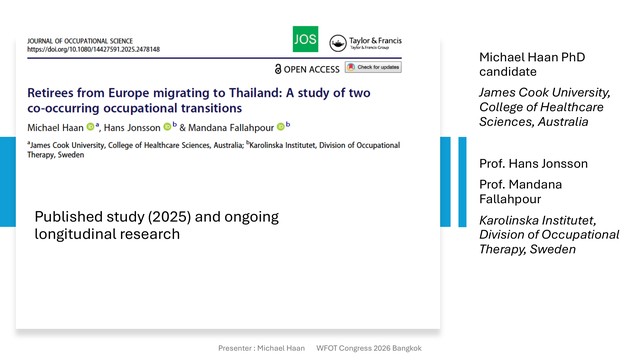
Introduction/Rationale: Moving as retirees to another country is an increasing trend in societies of the Global North, presenting retirees with co-occurring transitions: retiring and migrating to a new country. While much is known about these transitions individually, limited research has examined their co-occurrence and implications for occupational engagement. This study explores the unique challenges and opportunities arising from these intertwined transitions, contributing to the understanding of how retirees navigate this complex process.
Objectives: To explore and describe the co-occurring occupational transitions of retirement and migration among European retirees living in Thailand.
Methods/Approach: A constructivist grounded theory approach was employed. In-depth, semi-structured interviews were conducted with 21 retirees from Europe who migrated to Thailand. Data was analyzed inductively to identify themes describing the dynamic interaction of these transitions.
Results/Practice implications: Four distinct phases emerged in a co-occurring and intertwined transition process:
Beach period – characterized by exploration and novelty.
Real-life period – involving adaptation to daily routines.
Becoming established and connected – marked by a sense of stability and belonging and engagement.
Thoughts on health and the future – involving reflections on aging, dependence and possible return migration.
Occupational therapists can guide and support retirees through these transitions by promoting active aging and meaningful engagement in new cultural contexts.
Conclusion/Contribution to the occupational therapy profession: This study highlights the intertwined nature of retirement and migration transitions, highlighting the role of occupational therapy in facilitating adaptation and active aging for retirees navigating cross-cultural life changes.