
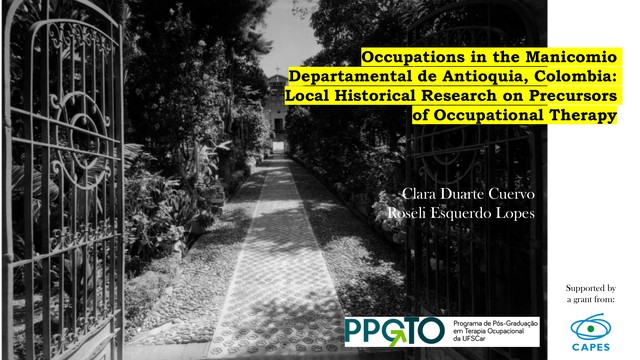
Introduction: Occupational therapy was formally introduced as a profession in Colombia in the 1960s. However, earlier practices incorporating occupations as a treatment for individuals with mental illness and those living in poverty existed but remain understudied. While historical analyses of psychiatric institutions have linked occupation to moral treatment, understanding the local appropriation of these practices requires consideration of social, political, cultural, and economic factors.
Objective: This study examines the historical use of occupations in the psychiatric asylum Manicomio Departamental de Antioquiain Medellín, Colombia, throughout its existence (1892 – 1958).
Methods: A historical research approach was employed to construct an archive of primary sources, including regulations, laws, scientific documents, press materials, images, patient medical records, and literature used by medical staff. Secondary historical sources provided additional context. Periodization was based on key transformations in occupational practices, analyzed within their broader sociopolitical contexts.
Results: Four historical periods were identified: (1) the asylum as a conducive environment for occupation, (2) occupation for calm patients, (3) occupation as a way of life in isolation, and (4) the introduction of ergotherapy. These transformations were influenced by changing perceptions of work and occupation, shifts in moral treatment principles, the transition from European to American influences, the interplay of medical and charitable ideologies, and the legitimation process of medical-psychiatric knowledge.
Conclusion: The importance of contextualizing the profession’s development within regional and historical structures is reaffirmed, to broaden the understanding about the socio-historical construction of occupational therapy throughout the world, in its common elements and its diversities.