
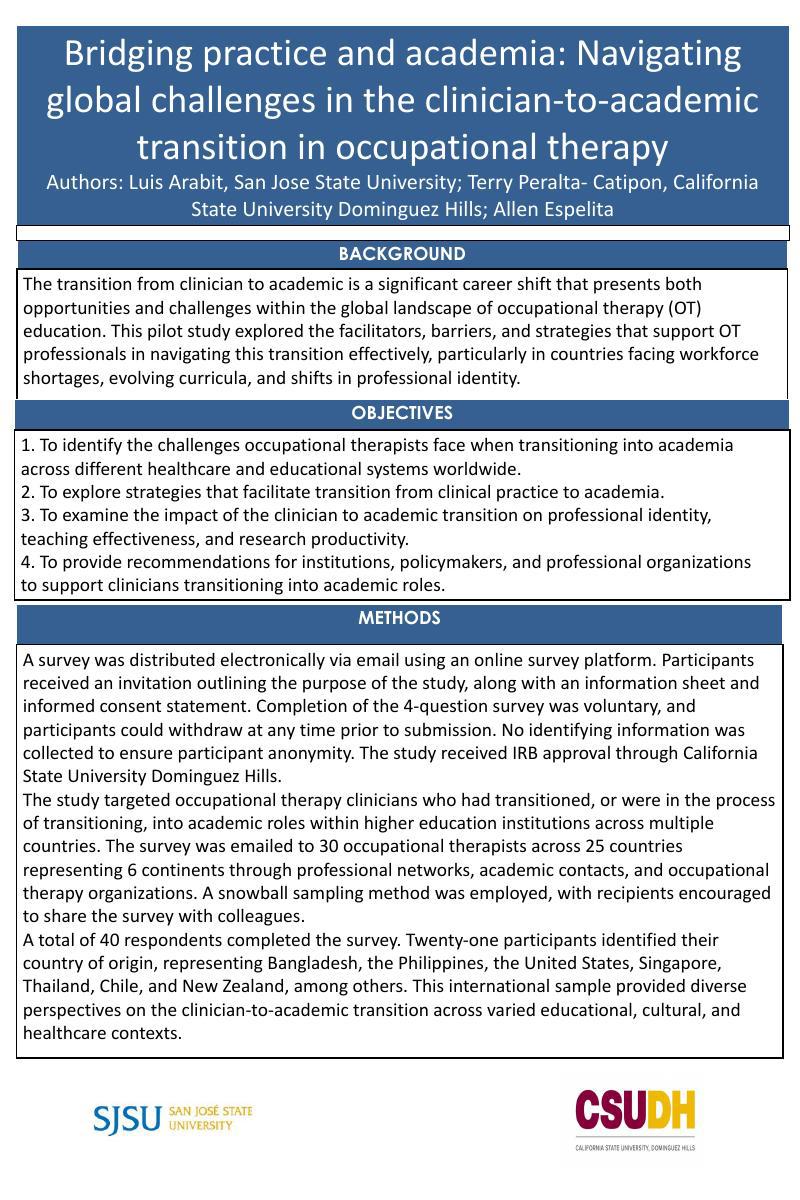
Introduction/Rationale: The transition from clinician to academic is a significant career shift presenting both opportunities and challenges within the global landscape of occupational therapy (OT) education. This presentation explores the facilitators, barriers, and strategies that support OT professionals in navigating this transition effectively, particularly in countries facing workforce shortages, evolving curricula, and shifts in professional identity. A special focus will be placed on emerging economies and countries with developing OT education. These countries may have a more complicated transition due to limited academic resources, Western-centric curricula, and the need for locally relevant teaching approaches. Strategies for mentorship, capacity-building, and academic-industry collaboration will be discussed.
Objectives:
1. To identify the challenges occupational therapists face when transitioning into academia across different healthcare and educational systems worldwide.
2. To explore strategies that facilitate transition from clinical practice to academia.
3. To examine the impact of the clinician to academic transition on professional identity, teaching effectiveness, and research productivity.
4. To provide recommendations for institutions, policymakers, and professional organizations to support clinicians transitioning into academic roles.
Methods/Approach: Expert evidence through direct interviews of practitioners from various countries; global case studies, and current evidence-based literature,
Results / Practice Implications: This presentation will examine key challenges such as, bridging the theory-practice gap in OT education, acquiring pedagogical skills for effective teaching and learning, addressing institutional and systemic barriers in academia, and integrating research and evidence-based practice into teaching.
Conclusion: This presentation will encourage dialogue among clinicians, educators, and policymakers to enhance the future of OT education globally. It will ensure that academics remain deeply connected to real-world practice and that clinicians feel empowered to transition into academic roles.