
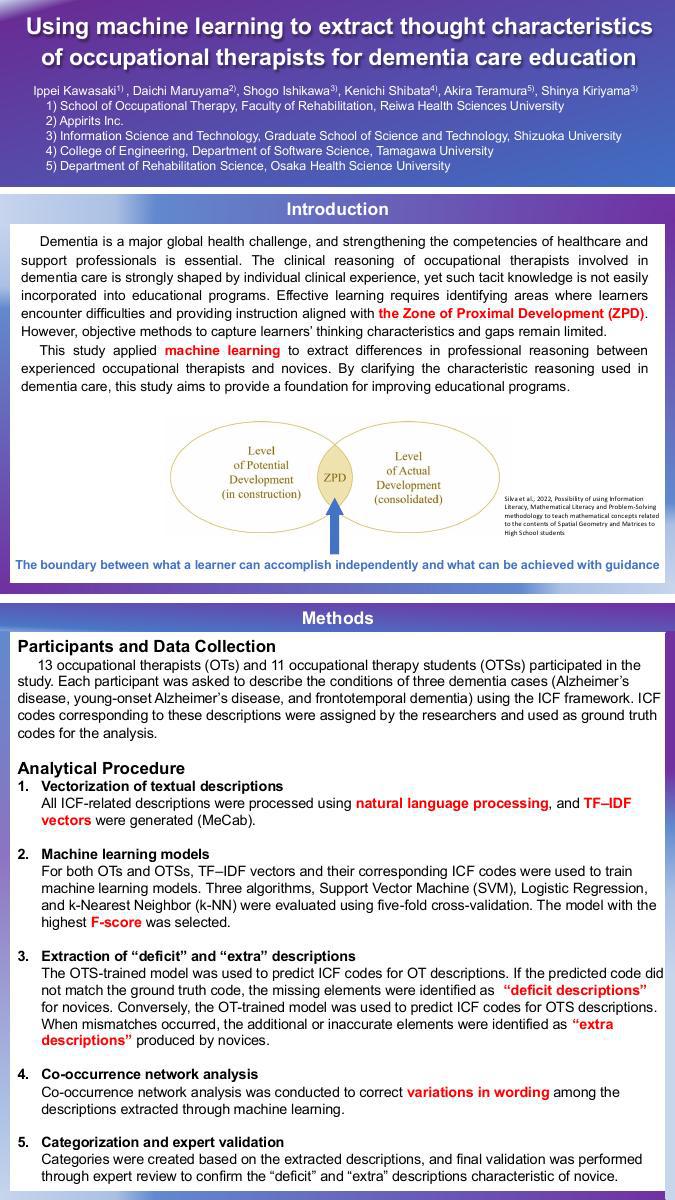
Introduction: Education for learners of dementia care is critically important. Identifying areas where learners encounter difficulties is essential for improving educational programs. This study utilized machine learning to compare the thought characteristics of novices and experts in dementia care and developed a method to detect novice obstacles.
Objectives: This study aimed to extract the thought characteristics of occupational therapists (OTs) in dementia care by analyzing novice difficulties, contributing to educational program development. The findings of this study have been published in a domestic academic journal.
Methods: A total of 13 occupational therapists (OTs) and 11 OT students (OTSs) were tasked with organizing case details for three types of dementia using the ICF. Text descriptions and ICF codes were collected. Natural language processing generated TF-IDF vectors, and cross-validation (n=5) was performed with Support Vector Machine (SVM), Logistic Regression, and k-Nearest Neighbor (k-NN) algorithms. The model with the highest F-score was selected. Predictions were compared with actual ICF codes to identify "deficit" and "extra" descriptions in novices.
Results: Novices in dementia care lacked descriptions regarding communication abilities and social connections, identified as deficit descriptions. Their responses contained vague and imprecise descriptions of cognitive functions and ADL, categorized as extra descriptions. Based on this, the thought characteristics of OTs were extracted.
Conclusion: This study highlights the potential for improving dementia care education by identifying novice difficulties and facilitating the extraction of OTs' thought characteristics. The method shows promise for enhancing healthcare and welfare training across diverse educational settings.