Introduction: Occupational therapy students complete 1000 hours of supervised clinical work in order to graduate. Stellenbosch University facilitates a role-emerging student clinical block at a clothing factory, where there is no on-site clinical occupational therapist (College of Occupational Therapists 2006). Limited information is available about the professional development of occupational therapy students and the development of graduate attributes (GA) at role-emerging clinical placements in low to middle income countries.
Objective: This study aimed to describe students' perceptions of the development of Stellenbosch University's (SU) Faculty of Medicine and Health Sciences (FMHS) GA within this role-emerging placement. Study design: Concurrent mixed methods study design (qualitative plus quantitative).
Methods: Total population sampling was used to recruit all final year students placed within the clothing factory clinical block during 2023 (n=8). Two data collection tools were used: 1) A rating scale where students rated their development in each GA on a weekly basis; 2) A weekly reflective journal, following the Gibbs reflective cycle (Gibbs, 1988), where students reflected on the development of GA during the past week.
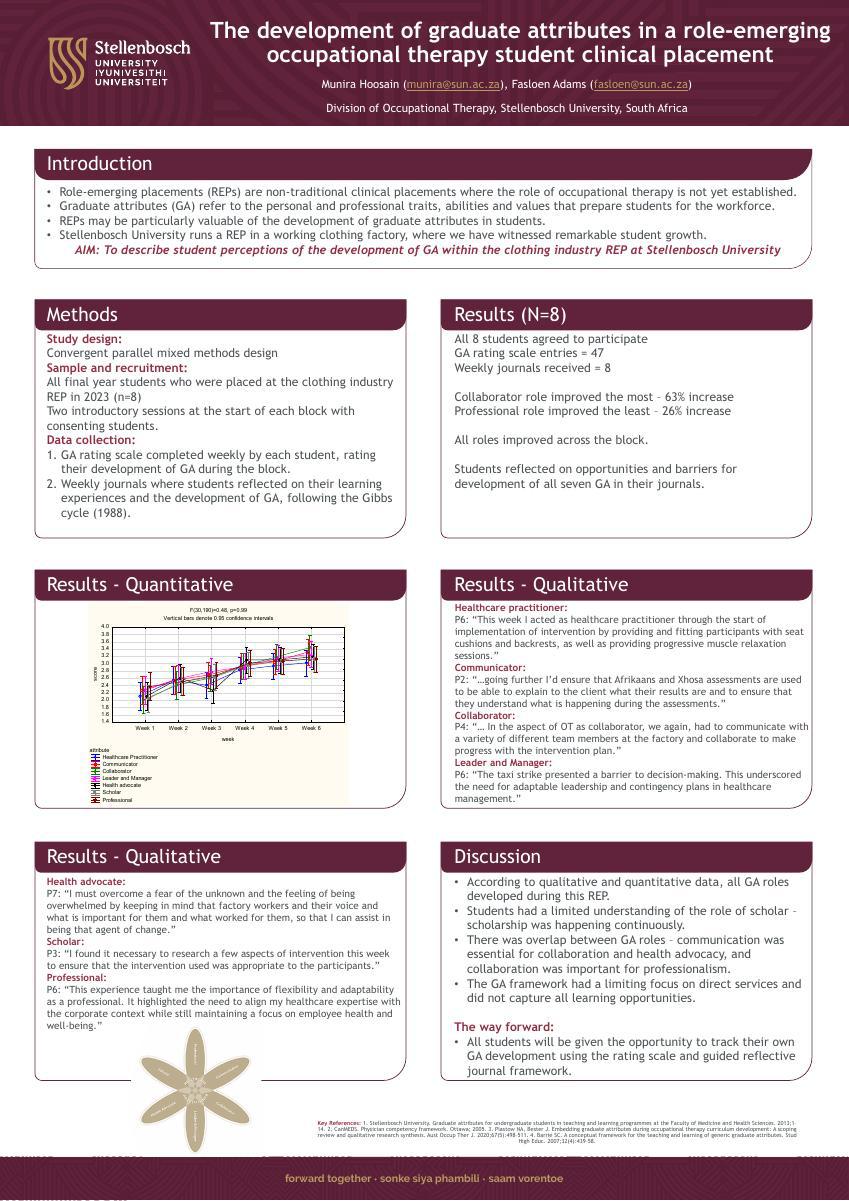
Results: 47 entries were made into the survey and eight students submitted reflective journals. Students improved in all graduate attribute roles, with Collaborator improving the most (63%) and Professional improving the least (26%). This was supported by the qualitative data (reflective journals), which were analysed using framework analysis (Gale, 2013). Evidence was found for each of the seven graduate attribute roles. Findings were confirmed using member checking.
Conclusion: Role emerging placements such as clothing factories and other workplaces provide a valuable setting for student development in LMICs.
