
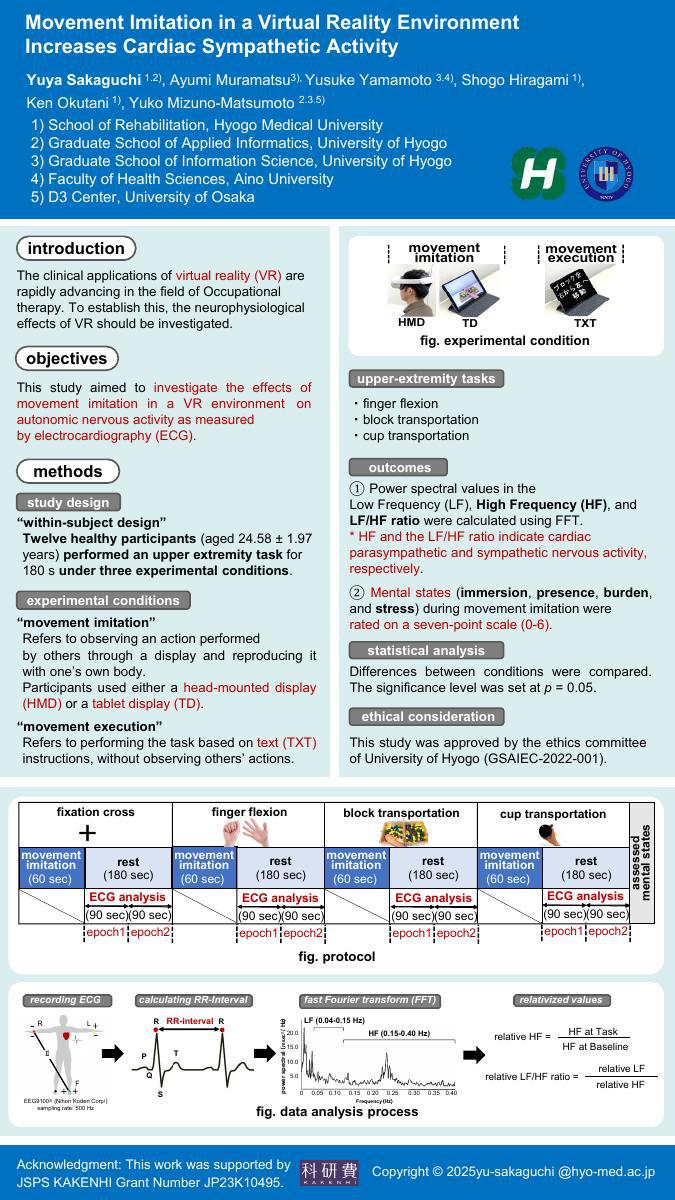
Introduction: The clinical applications of virtual reality (VR) are rapidly advancing in the field of occupational therapy. To establish this, the neurophysiological effects of VR should be investigated.
Objectives:This study aimed to investigate the effects of movement imitation in a VR environment on autonomic nervous activity as measured by electrocardiography.
Methods: Twelve healthy participants (aged 24.58±1.97 years) performed an upper extremity task for 180 s under three experimental conditions. In the movement imitation conditions, participants used either a head-mounted (HMD) or tablet (TD) display. In the movement execution condition, participants referred to the text (TXT). The upper-extremity task comprised finger flexion, block transportation, and cup transportation. Power spectral values in the LF (0.04–0.15 Hz), HF (0.15–0.40 Hz), and LF/HF ratio were calculated using a fast fourier transform (FFT). HF and the LF/HF ratio indicate parasympathetic and sympathetic nervous activity, respectively. Statistical analysis was performed using multiple comparisons to evaluate the differences between experimental conditions. The significance level was set at p = 0.05. All the participants signed an informed consent form before participating in the study.
Results: The LF/HF ratio was significantly higher in the HMD condition than in the TXT and TD conditions. Contrastingly, the LF and HF values were not significantly different among all the conditions.
Conclusion: Movement imitation in a VR environment increases the cardiac sympathetic nervous activity associated with arousal and concentration. This finding suggests that such an approach may enhance participants' engagement in occupational therapy programs.