
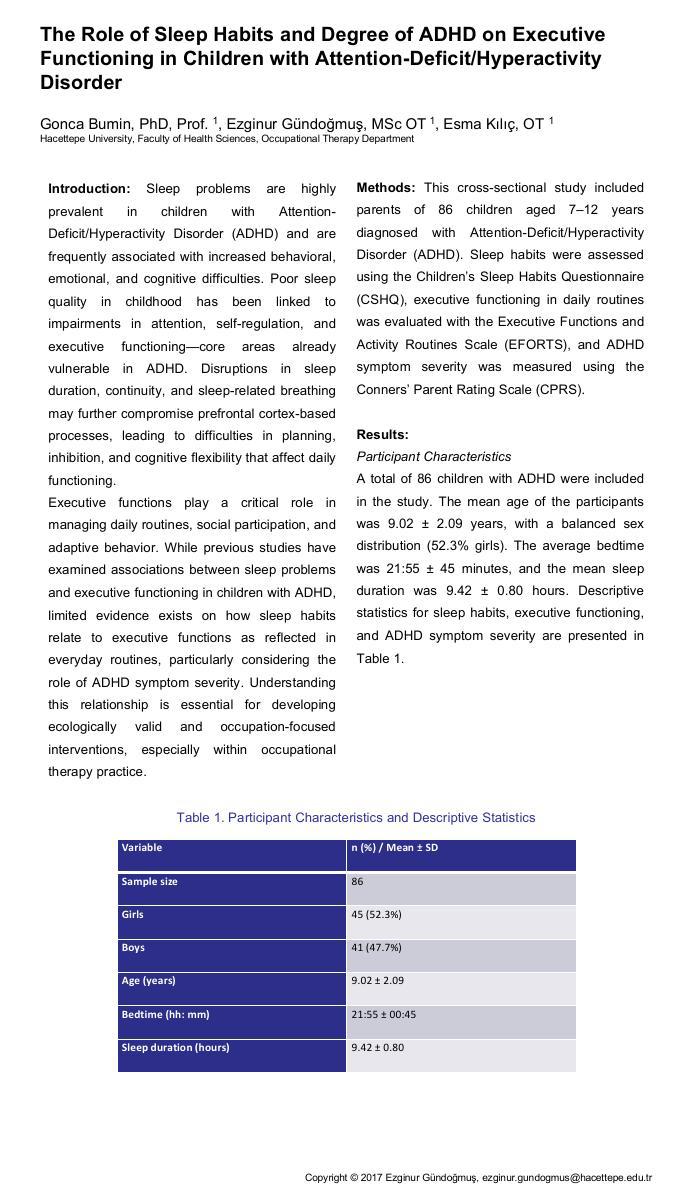
Introduction/ Rationale: ADHD is the most common chronic neurodevelopmental disorder of childhood, characterized by impulsivity, inattention, and hyperactivity inappropriate. Studies have shown that children with ADHD have disturbed sleep habits and disorders. It is also known that children with ADHD have problems with executive functions (EF), such as sustaining attention, making sense of events, processing and using information, and making connections between situations. However, studies on the effect of sleep problems and the degree of ADHD on executive functions are limited.
Objectives: This study aimed to evaluate the effect of sleep habits and the degree of ADHD on EF in children diagnosed with ADHD.
Methods/ Approach: This cross-sectional descriptive study was conducted with 30 parents of children aged 7-12 with ADHD. Sleep habits were assessed with the Children's Sleep Habits Questionnaire (CSHQ), ADHD severity with the Conners' Parent Rating Scale-Short Form (CPRS-SF), and EF with the Executive Function and Occupational Routines Scale (EFORTS).
Results / Practice Implications: There were significant correlations between CSHQ total and EF morning and evening (r=-0.88,p<0.001), school and leisure (r=-0.66,p<0.001), social routines (r=-0.48,p<0.001) and total EF score (r=-0.96,p<0.001). There were also significant correlations between the CPRS-SF total score and morning and evening (r =-0.64,p<0.001), school and leisure (r=-0.36,p=0.04), social routines (r= -0.42,p<0.01) and total EF score (r =-0.70,p<0.001).
Conclusion / Significance to the Occupational Therapy Profession: These findings suggest that impaired sleep habits and increased ADHD degree negatively affect the maintenance of routines related to EF. Therefore, occupational therapists working with ADHD should consider sleep habits and the degree of ADHD when intervening in children's participation in daily, school, leisure, and social routines.