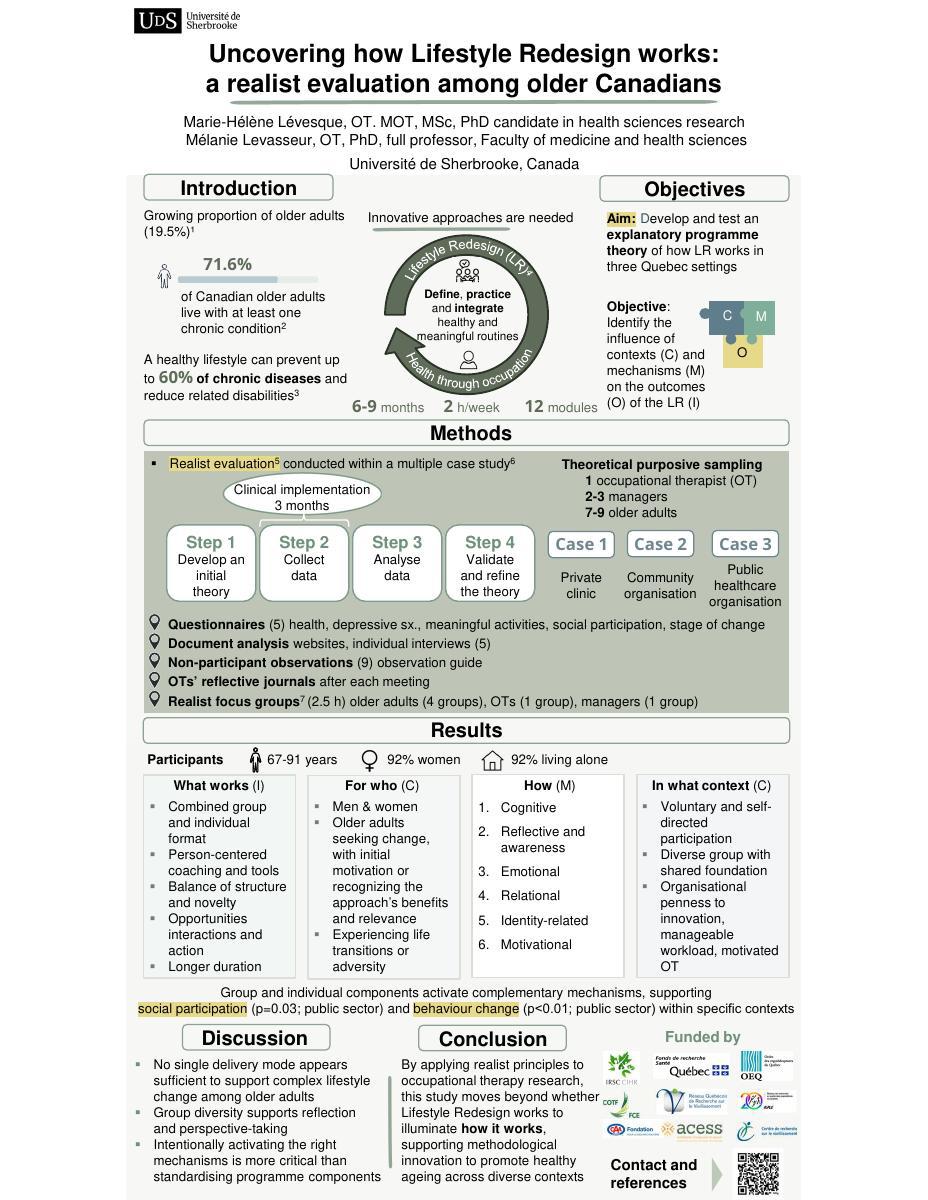
Introduction: Health is a fundamental right, requiring innovative approaches to promote healthy aging, such as Lifestyle Redesign, an occupational therapy approach fostering meaningful and healthy routines. Although well recognized for its efficacy and cost-effectiveness, the approach’s causal mechanisms remain unexplored.
Objectives: This study aimed to explain the functioning of the Lifestyle Redesign by identifying the influence of context (C) and mechanisms (M) on outcomes (O) such as health, depressive symptoms, meaningful activities, social participation, and behavioral change.
Methods: A three-month, multiple-case realist evaluation was conducted in three Quebec settings (public, private and community), each involving one occupational therapist, their manager, and 7–9 older adults. CMO hypotheses were developed and refined through document review, interviews (n=5), observations (n=9), and focus groups (n=6). Thematic content analysis, combined with descriptive and comparative statistics, revealed key mechanisms and regularities across cases.
Results: Participants (67–91 years, 92% women, 92% living alone) benefited from group interventions that activated social mechanisms through interaction, enjoyment, feedback, and exposure to new perspectives. These mechanisms fostered connection, self-awareness, mutual understanding, and inspiration, supporting attitudes and behaviors that fostered social participation (p = 0.03; public sector). Personalized coaching, through meaningful conversations and experiential learning, helped individuals confirm their path or consider better or different choices. This process fostered awareness, opened new possibilities, and supported progression through the stages of change (p ˂ 0.01; public sector), leading to healthier behaviors and improved well-being.
Conclusion: By applying realist principles to occupational therapy research to uncover how Lifestyle Redesign works, this study inspires methodological change toward innovative solutions that promote and protect the health of older Canadians.
