
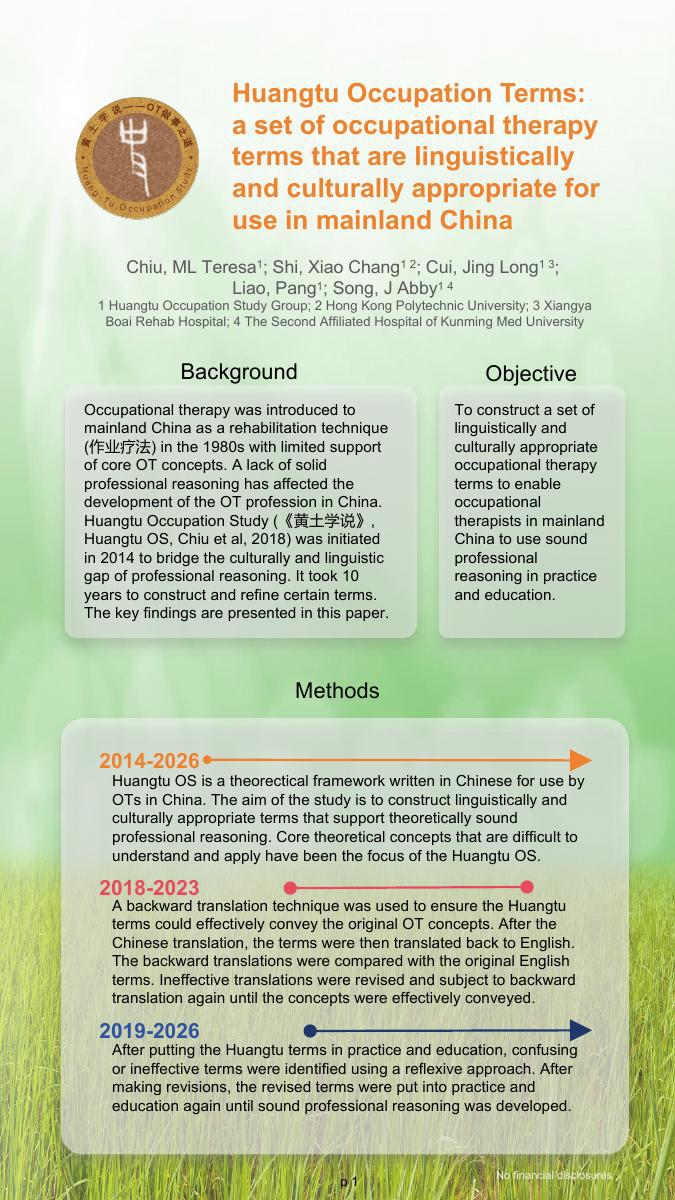
Introduction: In the 1980s, occupational therapy was considered as a rehabilitation technique when introduced to mainland China. There were limited linguistically and culturally appropriate explanations of core OT concepts.
Objectives: To construct a set of occupational therapy terms that are linguistically and culturally appropriate for use in mainland China that can convey OT concepts accurately.
Methods: There were three phases in this study. 1) 2014 – 2018: To construct a framework that is linguistically and culturally appropriate for use in China. 2) 2018-2023. A backward translation technique was used to ensure OT concepts were conveyed accurately. 3) 2019-2024. Using a reflexive process, unclear terms were revised until they could convey OT concepts accurately.
Results: 1) A set of Huangtu Occupation terms was constructed based on the Chinese traditional thinking using two criteria: The terms could convey the original concepts of OT and were linguistically and culturally meaningful for use in China. 2) Using the Huangtu terms, 13 articles and book chapters of OT concepts such as occupational performance, client-centered practice were translated into Chinese. Next, they were backward translated into English. The backward translations were compared with the original articles word by word. Unclear wordings, explanations and concepts were revised. 3) Reflexive accounts of the use of Huangtu terms in practice were examined. Revisions were made to improve the linguistic and cultural appropriateness and the conceptual accuracy of the terms until the therapists could demonstrate effective use of the terms.
Conclusion: By bridging the linguistic and cultural gap, the Huangtu Occupation terms have enabled occupational therapists to understand and use occupational therapy core concepts professionally and accurately.