
Introduction There are several techniques in hand rehabilitation for children with cerebral palsy, focusing on improving motor skills, coordination, and functional independence. Mirror therapy, originally developed for patients with phantom limb pain and later adapted for stroke rehabilitation, has shown potential benefits in enhancing motor recovery by engaging neural plasticity through visual feedback. However, its application in children with cerebral palsy remains underexplored.
Objective This study aims to bridge this gap by designing a modified mirror therapy program tailored to the unique needs of children with spastic cerebral palsy.
Methods In this pilot study, a mirror therapy technique was redesigned to appropriately fit children. The technique was then studied in eight children with spastic cerebral palsy aged between 3-8 years. Outcome measurements were the ability to perform the Modified Jebsen-Taylor Test of Hand Function (MJTHT) and the ability of hand and arm control, which were assessed on day 1, at 1 month, and at 3 months after day 1.
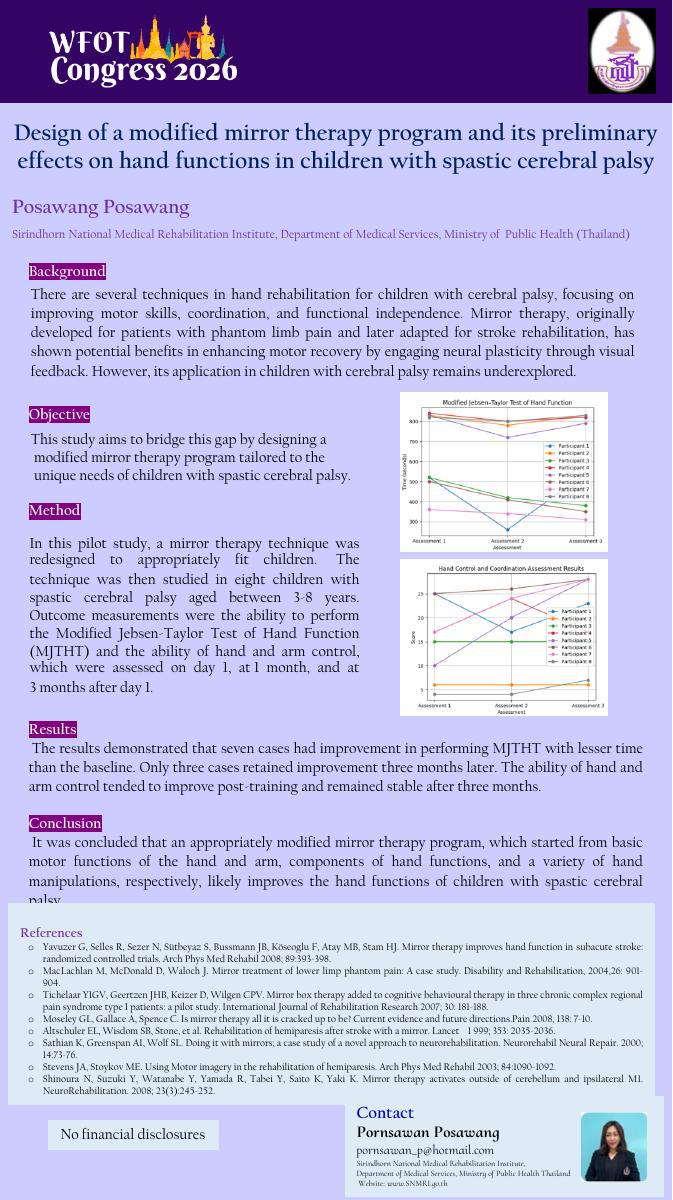
Results The results demonstrated that seven cases had improvement in performing MJTHT with lesser time than the baseline. Only three cases retained improvement three months later. The ability of hand and arm control tended to improve post-training and remained stable after three months.
Conclusion It was concluded that an appropriately modified mirror therapy program, which started from basic motor functions of the hand and arm, components of hand functions, and a variety of hand manipulations, respectively, likely improves the hand functions of children with spastic cerebral palsy.