
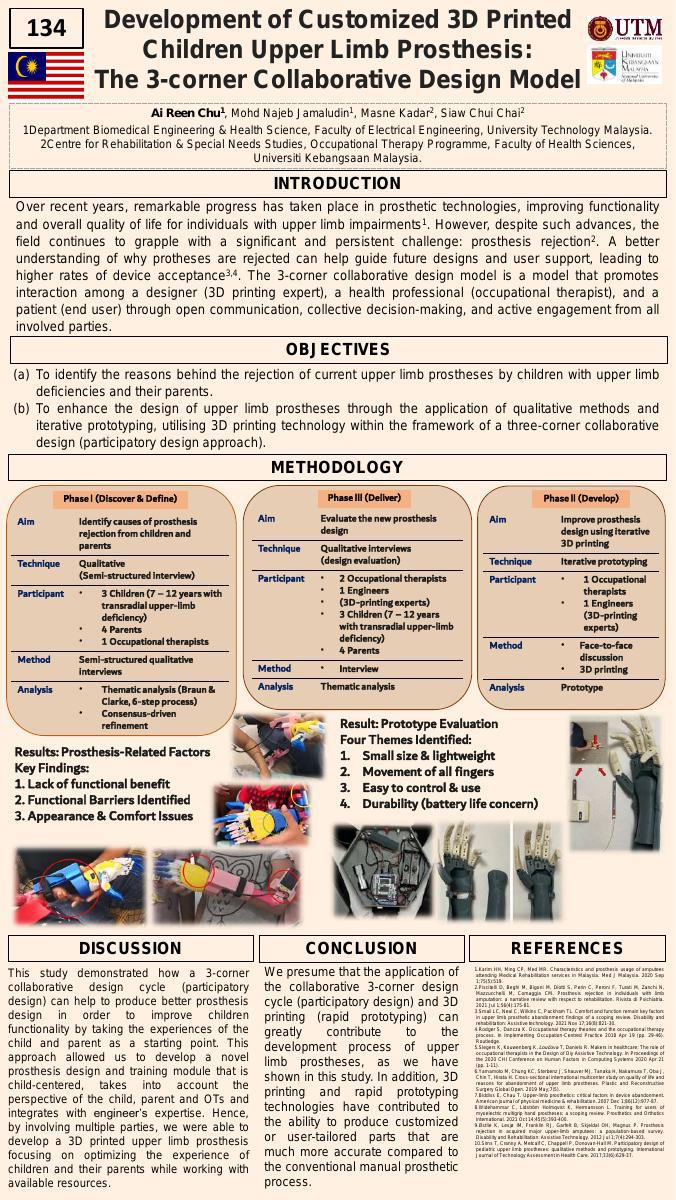
Introduction: The 3-corner collaborative design model is a model that promotes interaction among a designer (3D printing expert), a health professional (occupational therapist), and a patient (end-user) wherein specialists from many disciplines exchange their expertise through open communication, collective decision-making, and active engagement from all involved parties.
Objective: This study aims to investigate the cause of rejection of current upper limb prostheses by experienced children with upper limb deficiency and their parents, employing qualitative methods to identify potential improvement in prosthesis design through iterative prototyping (utilizing 3D printing) within a three-corner collaborative design framework (participatory design approach).
Methods: Twelve participants including three children aged 7-12 years with trans-radial amputation, three mothers, one father, one 3D printing expert, and four occupational therapists, contributed to the development of a new design through the 3-corner collaborative design model, employing interviews and iterative prototyping with 3D printing.
Results: The study identified areas for improving prostheses from the perspective of children and parents, developed prototypes based on these, and gained feedback on the prototypes from the children and parents of children's upper limb prostheses. Future device development needs to focus on size and ease of use.
Conclusion: This study has demonstrated that occupational therapists and children can and ought to participate as collaborators in the development of upper limb prosthesis and that rapid prototyping (3D printing), employed within the 3-corner collaborative design (participatory design approach) methodology, serves as an effective tool for enabling this process.