
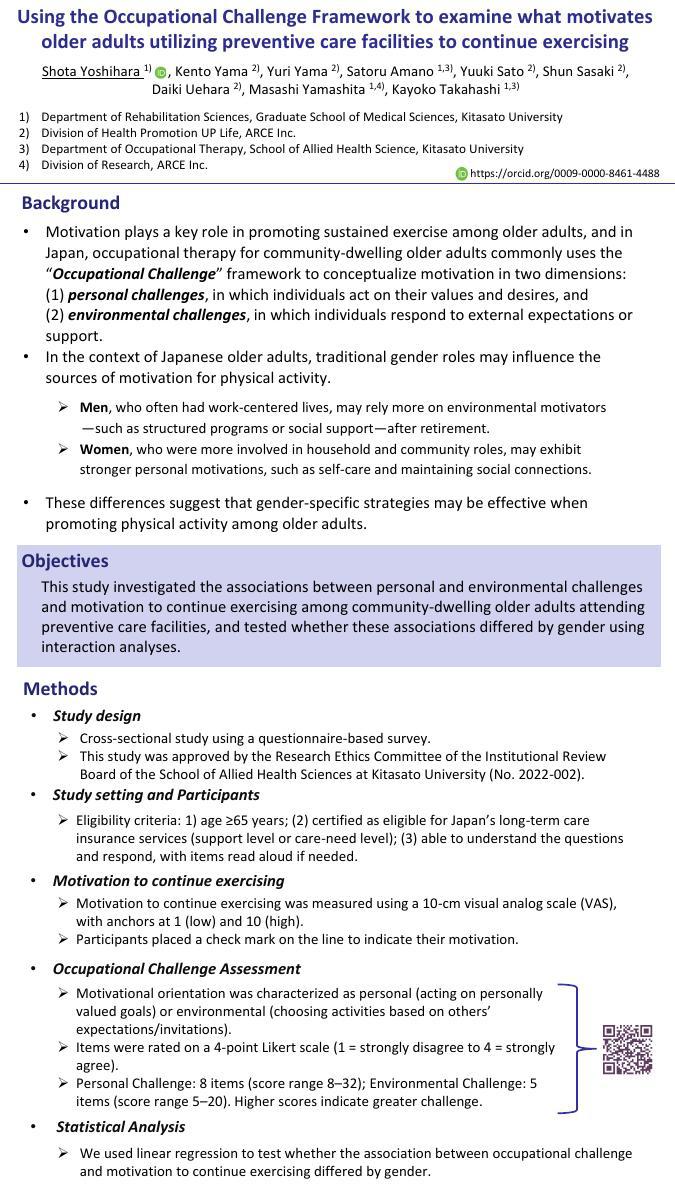
Introduction: Motivation plays a key role in promoting exercise continuation among older adults. In Japan, occupational therapy for community-dwelling older adults uses the "Occupational Challenge" framework to classify motivation into two dimensions: (1) personal challenges, where individuals act on their values and desires, and (2) environmental challenges, where individuals respond to external expectations or support.
Objectives: This study examined the association between personal and environmental challenges and the willingness to continue exercising among community-dwelling older adults utilizing preventive care facilities.
Methods: This cross-sectional study was conducted on community-dwelling older Japanese adults. Willingness to continue exercising was measured with a visual analog scale. Personal and environmental challenges were assessed using the Occupational Challenge Assessment, and participants were categorized into tertile-based groups (low, moderate, high) for each challenge. Linear regression models, adjusted for age, sex, and care levels, were used to analyze the association between personal and environmental challenges and the willingness to continue exercising.
Results: A total of 109 participants (mean age: 79.1 ± 5.4 years; 57% female) were included. Higher personal challenge levels were significantly associated with a greater willingness to continue exercising (P for trend < 0.01). Although not statistically significant, environmental challenges also showed a potential trend (P for trend = 0.08).
Conclusion: Our findings highlight the need to align exercise interventions with individual motivations and values. Additionally, environmental factors may play a potential secondary role, warranting further investigation into their interaction.