
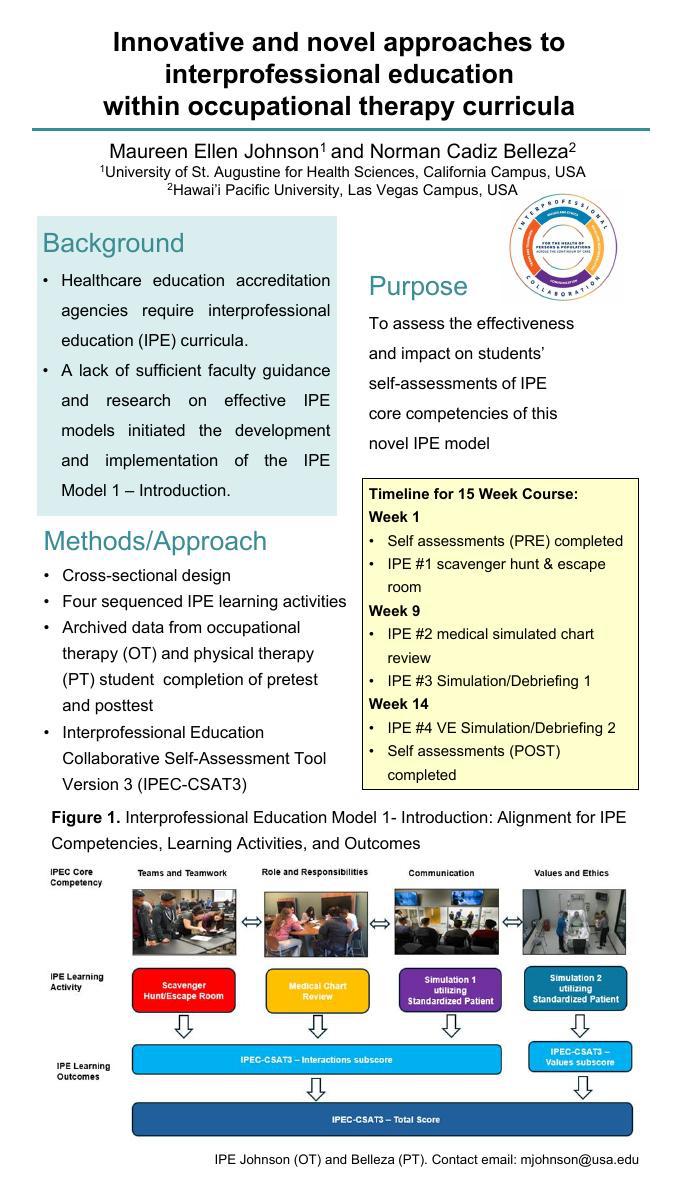
Introduction/Rationale: Healthcare education accreditation agencies worldwide require the inclusion of interprofessional education (IPE) curricula. A lack of sufficient faculty guidance and research on effective IPE models initiated the development and implementation of the IPE Model 1 – Introduction.
Objectives: This cross-sectional study assessed the effectiveness of this novel IPE model using one year of data to measure the impact on students’ self-assessments of IPE core competencies.
Methods/Approach: Archived data from auto-enrolled occupational therapy (OT) and physical therapy (PT) student assignments (N=280) across three 15-week terms in 2019: spring (n=56); summer (n=106), and fall (n=118) were de-identified and collected from those who participated in all four sequenced IPE learning activities including escape rooms, annotative lectures, medical chart reviews, and simulations with debriefing. Students completed a pretest and posttest of the Interprofessional Education Collaborative Self-Assessment Tool Version 3 (IPEC-CSAT3) during the course.
Results/Practice Implications: Total assignments analyzed (N=266) were from OT (n=101) and PT (n=165). A Wilcoxon signed-rank test demonstrated significant improvement in total scores and the Interactions and Values subscores from the IPEC-CSAT3. No significant difference among disciplines or gender was found using the Kruskal-Wallis test. By providing several IPE learning activities, students experienced increased confidence, improved self-ratings, and a heightened sense of salience in IPE interactions thereby promoting future improved patient safety and outcomes.
Conclusion/Contribution to the occupational therapy profession: This innovative model provided significant improvement on all measures of the IPEC-CSAT3 and were consistently advantageous for both OT and PT students. The potential benefits of the IPE Model 1 – Introduction extend beyond OT and PT, suggesting its efficacy in improving IPE competencies and collaborations with other healthcare students.