
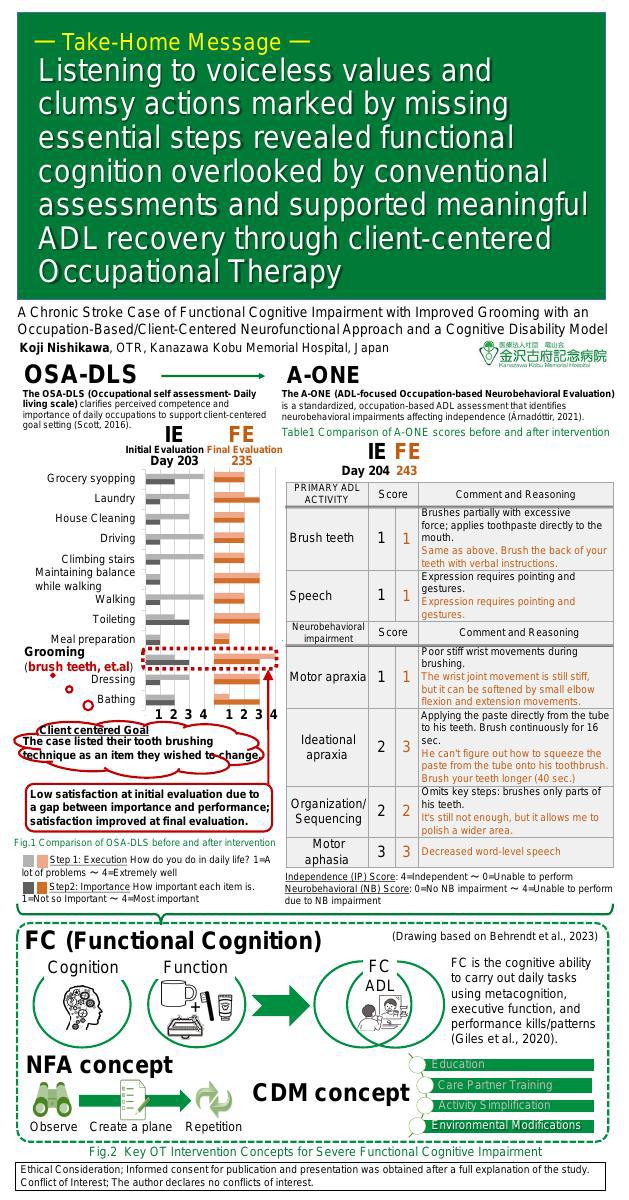
Introduction: Chronic brain injury patients with severe cognitive impairment have low ADL independence to learning decline and require an effective approach. Written informed consent was obtained from the case.
Objective: A case report of a chronic stroke patient who improved Occupational performance(OP) using a neurofunctional approach(NFA; Giles, 2014)and a cognitive disability model(CDM; McKenzie, 2023).
Methods: The case of a former carpenter is a man in his 50s with left thalamic hemorrhage who underwent modified NFA and CDM from Day 207 to 249. OP and importance were evaluated by Occupational Self Assessment-Daily Living Scale(OSA-DLS) because of motor aphasia. Toothbrushing was the task he wanted to change, with the largest gap between "Some Difficult" and "More Important". In the standardized A-ONE(Árnadóttir OT-ADL Neurobehavioral Evaluation), The toothbrush movement was clumsy and required physical assistance, which was thought to motor apraxia. Ftugl-Meyer-Assessment(FMA); 73 points. Although he couldn't use his hands, he could independently push a wheelchair. Modified NFA was errorless learning to watch YouTube with instructions on correct toothbrushing procedures, polishing a hanger with a toothbrush attached to sandpaper, brushing a dental model, brushing his teeth, and guiding him before the error appeared.
Results: There was an improvement in fine motor movements in tooth brushing, but motor apraxia remained. The patient changed from a manual to an electric-assisted toothbrush in a cognitive impairment model of environmental modification. As a result, FMA; 87 points. OSA-DLS(toothbrush) improved to "Extremely Well".
Conclusion: Because NFA and CDM improve OP in patients with chronic stroke cognitive impairment, it is important to consider them as functional cognition rather than assessing cognitive function and ADL separately, and to practice them repeatedly in client-centered OT.