
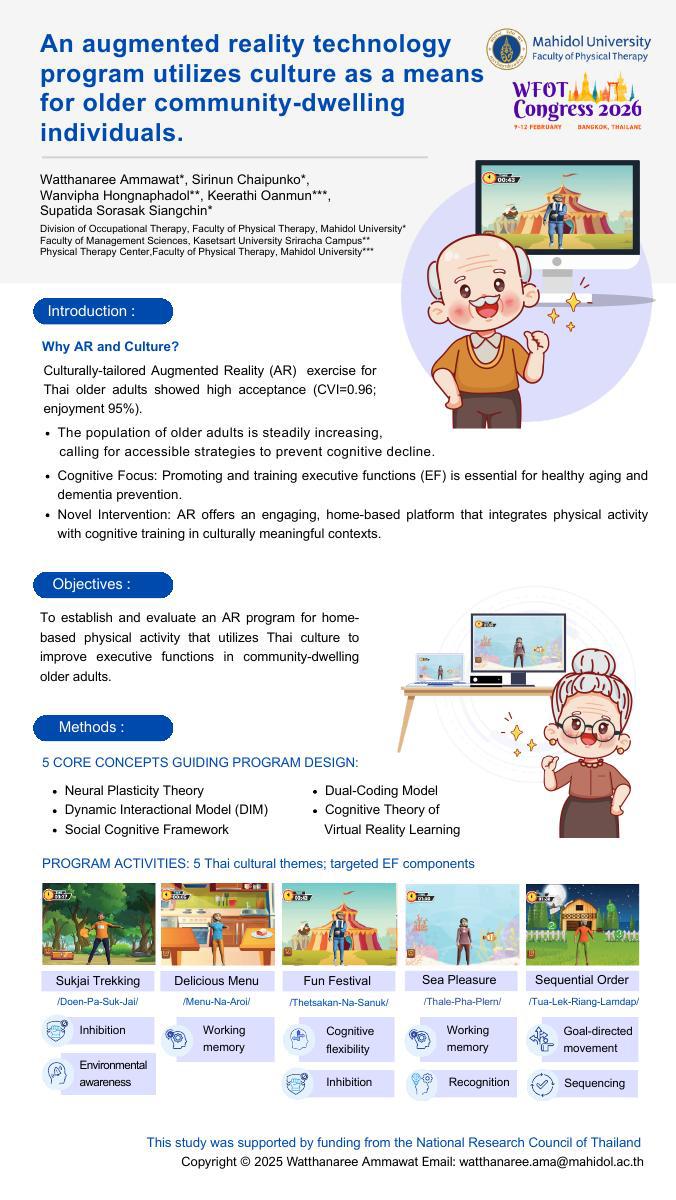
Introduction/Rationale: The elderly population is steadily growing in proportion to the global population. With this demographic shift, promoting brain health and preventing cognitive decline are critical goals in public health. The application of augmented reality (AR) technology offers a novel approach to enhancing brain function through culturally relevant physical activities.
Objectives: This study explores the development of a home-based AR program aimed at improving executive functions in community-dwelling older adults.
Methods: The AR program was developed using Unity Software and grounded in five key theories: Neural Plasticity Theory, Dynamic Interactional Model (DIM), Social Cognitive Framework, Dual-Coding Model, and Cognitive Theory of Virtual Reality Learning. We recruited participants (n = 20) to evaluate the program's effectiveness and user satisfaction.
Results: The AR program incorporates five culturally inspired activities that align with the Thai context: Sukjai Trekking, Fun Festival, Delicious Menu, Sea Pleasure, and Sequential Order. The developed program had a content validity of 0.96, indicating high relevance and consistency with the underlying theories. Sukjai Trekking and Sea Pleasure activities received the highest satisfaction ratings, at 65% and 75%, respectively. Content promoting practical application in daily life accounted for 60% of satisfaction responses. The screen design’s appropriateness and ease of use were rated at a medium level, accounting for 50% satisfaction.
Conclusion /Contribution to the Occupational Therapy Profession: In the context of Thai society, older adults have expressed high satisfaction with the newly developed technology. This indicates its potential to enhance executive functions in community-dwelling elderly individuals by incorporating culturally relevant physical activities, serving both as a form of leisure and a valuable tool for occupational therapy.