
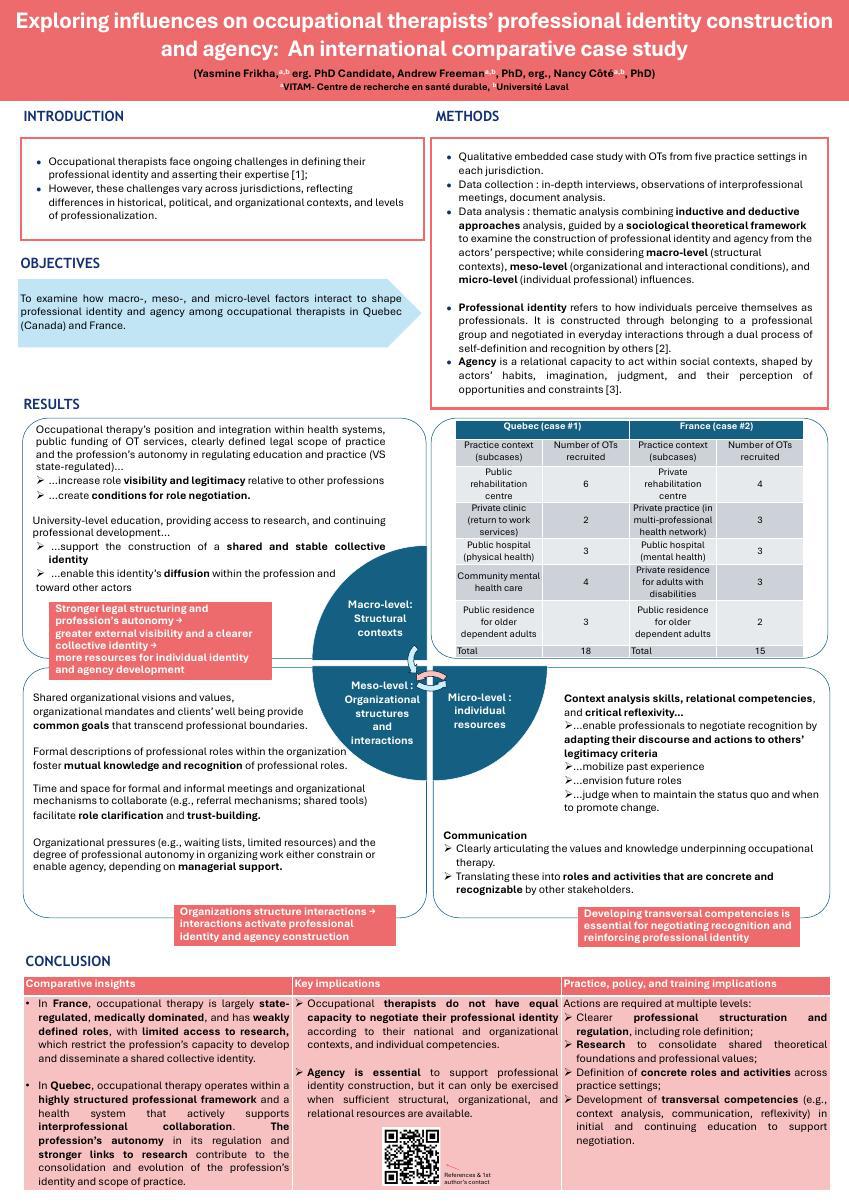
Introduction: Occupational therapists face challenges in defining their professional identity and asserting their expertise. However, the nature of these challenges, and their underlying causes, are not necessarily identical across jurisdictions. Therapists might encounter different opportunities and constraints depending on their historical, political, and organizational contexts and occupational therapy’s level of professionalization.
Objectives: This study examines the interplay of macro-, meso-, and micro-level factors in shaping occupational therapists’ professional identity and agency in Québec (Canada) and France.
Methods: We conducted a qualitative case study with occupational therapists from five practice settings in each jurisdiction. Data were collected through in-depth interviews and observations of interprofessional meetings. Thematic analysis, guided by sociological theories of professional identity, agency, and anglo-governmentality, explored the connections between macro- (political, societal), meso- (organizational), and micro-level (individual professional) influences on the construction of professional identity and agency at individual and collective levels.
Results: Occupational therapy’s position relative to other health professions and the recognition of rehabilitation within a biomedical framework shape professional identity and agency. Key factors include: state and professional regulations; funding models; professionalization of other professions; political representation; educational pathways, including entry-level, graduate, and continuing education opportunities. These factors influence occupational therapists’ ability to define their professional identity, gain recognition, and develop the agency to assert and expand their expertise.
Conclusion: This research provides insights regarding strategies for optimizing the position of the occupational therapy profession. It highlights pathways to foster agency among practitioners and reinforce their professional identity in their specific context.