
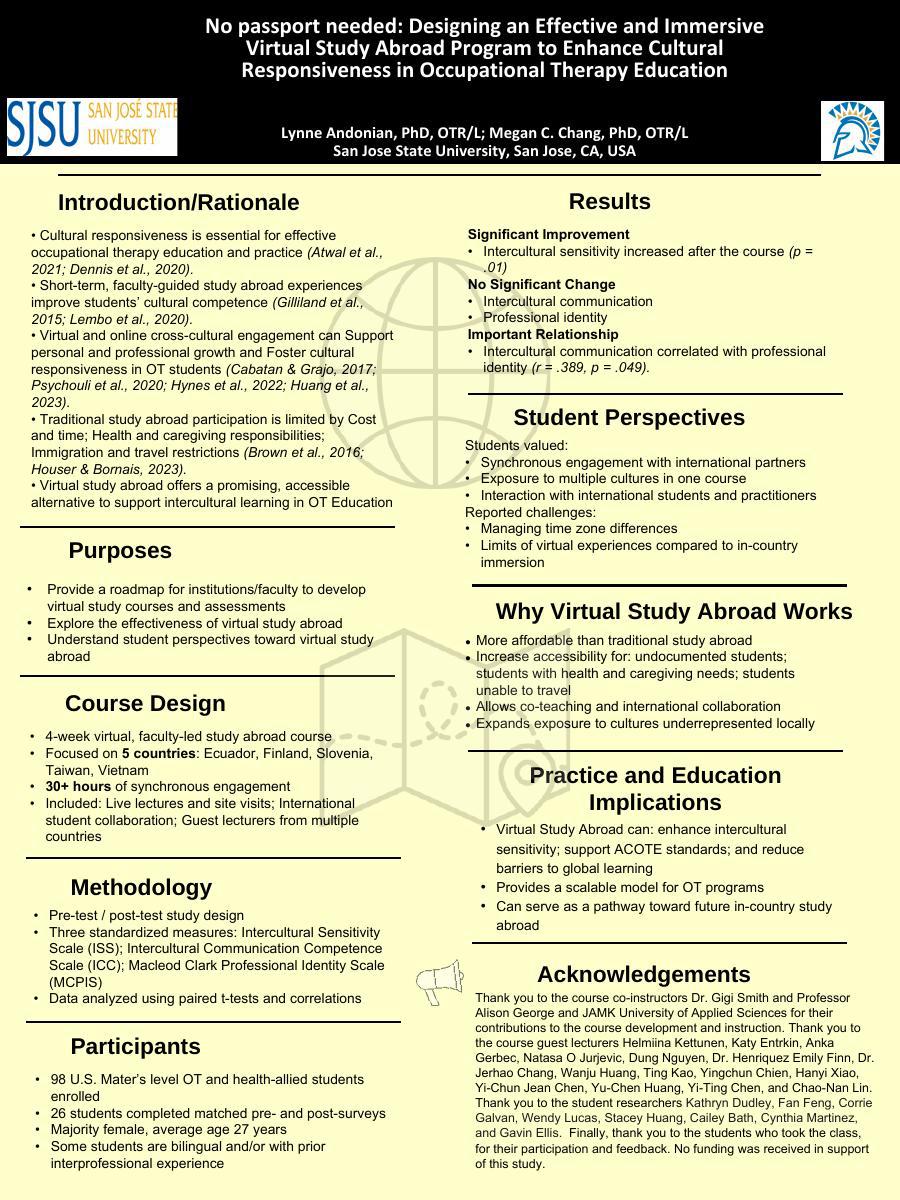
Introduction / Rationale: Cross-cultural education is critical in preparing culturally competent providers, which is an essential component in occupational therapy (OT) education/practice (Atwal et al., 2021; Dennis et al., 2020). While short-term study abroad programs can lead to significant cultural competency gains (Gilliland et al., 2015; Lembo et al., 2020), virtual cross-cultural engagement enhances personal growth (Psychouli, Collins, & Zadnik, 2020) and fosters cultural responsiveness in OT students (Huang, Terry, & Peck, 2023; Hynes, Hills, & Orban, 2022).
Objectives: 1. Provide a roadmap/detailed course description/assessments) for institutions to develop virtual study abroad programs 2. Understand the effectiveness of virtual study abroad 3. Learn student perspectives toward virtual study abroad
Methods / Approach: The four-week virtual study abroad course included five countries from three continents: Ecuador, Finland, Slovenia, Taiwan, and Vietnam. The course design included synchronous lectures, virtual site visits, and international student group interaction. Twenty-six of 98 USA Masters’ OT students provided course feedback and completed three assessments: Intercultural Sensitivity Scale (Chen & Starosta, 2000), Macleod Clark Professional Identity Scale (Worthington, Salamonson, Weaver, & Cleary, 2012), and Intercultural Communication Competence Scale (Arasaratnam, Banerjee, & Dembek, 2010) at the beginning/end of the course.
Results / Practice Implications: Students’ intercultural sensitivity scale scores increased significantly (p = 0.01); however, professional identity and intercultural communication did not change significantly. Students valued the synchronous course design, engagement with multiple cultures, and access for students with documentation/financial issues.
Conclusion / Contribution to the occupational therapy profession: Guided cross-cultural engagement through virtual abroad courses prepares OT students to work effectively with diverse populations. This course roadmap may support other institutions’ development of immersive/accessible virtual study