
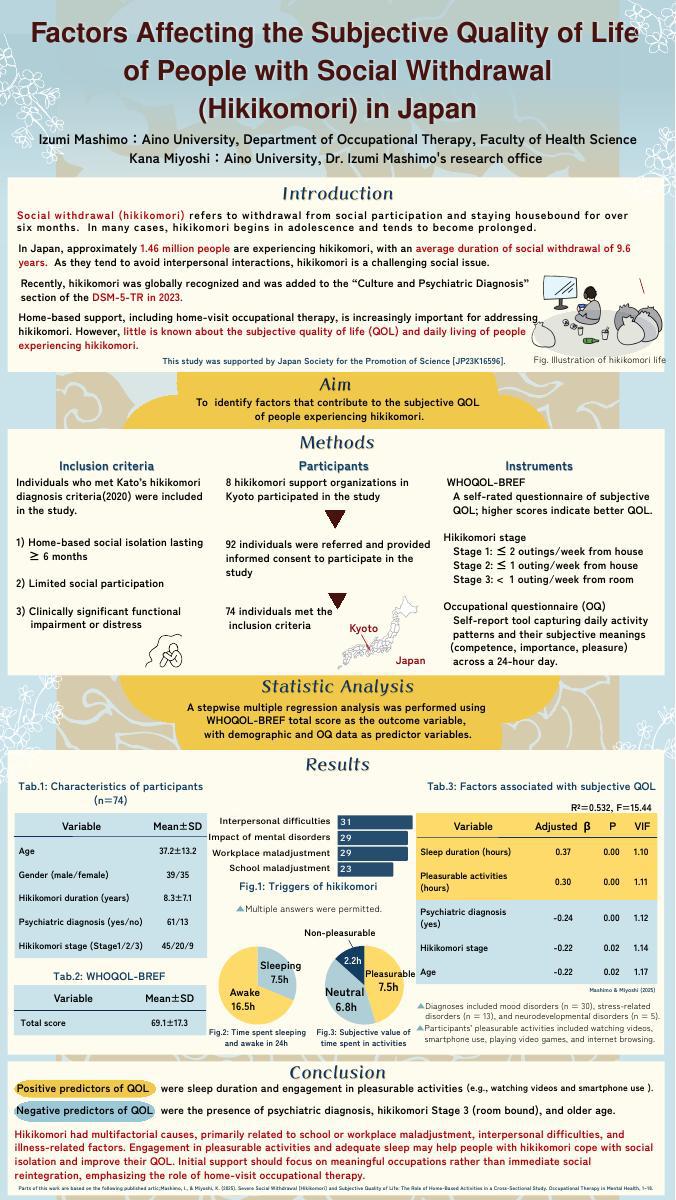
Introduction: Social withdrawal (i.e., Hikikomori) refers to withdrawal from social participation and staying housebound for over six months. About 1.46 million people in Japan have Hikikomori, with an average withdrawal period of 9.6 years, making it a significant social issue. Hikikomori is now recognized globally and was added to the “Culture and Psychiatric Diagnosis” section of the DSM-5-TR in 2023. However, little is known about the subjective quality of life (QOL) of those experiencing Hikikomori.
Aim: This study aimed to identify factors that contribute to the subjective QOL of people with Hikikomori.
Method: Ninety-two individuals were referred by Hikikomori-Support Teams, clinics, and parent associations. This study included 74 people who met the Hikikomori diagnostic criteria by Kato TA et al. (2019). Participants completed the WHOQOL-BREF and Occupational Questionnaire (OQ) to evaluate their daily activities. A stepwise multiple regression analysis was performed using the WHOQOL-BREF total score as the outcome variable, with demographic and OQ data as predictor.
Results: Participants’ (n=74) mean age was 37.2±13.2, male were 39 (52.7 %), and social withdrawal duration averaged 8.3±7.1 years. Sixty-one participants (82.4%) had a psychiatric diagnosis. Predictors of subjective QOL were sleep time (adjusted β =0.41), time spent doing enjoyment activities (adjusted β=0.33), age (adjusted β = -0.22) , and rarely leaving their room (adjusted β = -0.22) . The contribution rate of the model was 42.5% (p <0.01). There was no multicollinearity between variables.
Conclusion: Sleep and enjoyment in social withdrawal life positively impacted subjective QOL, while room-bound and old age negatively impacted it. It’s necessary to promote occupational therapy to improve subjective QOL of people with Hikikomori.