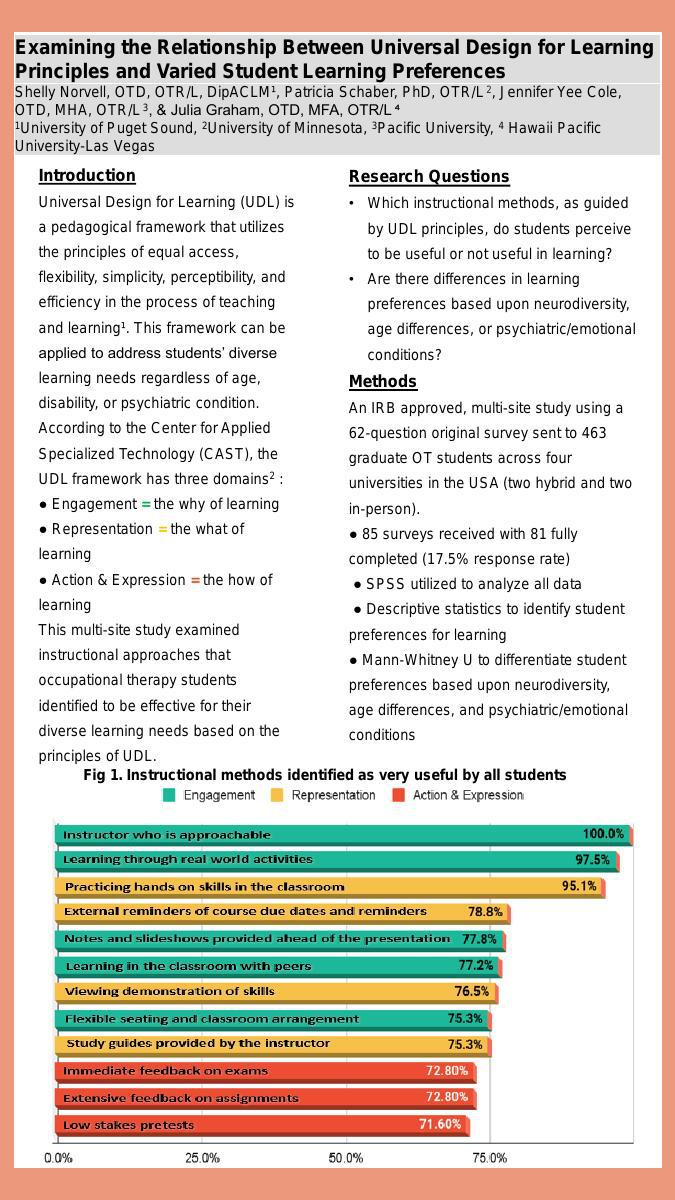
Introduction / Rationale: Universal Design for Learning is a pedagogical framework that can be applied to address students' diverse learning needs regardless of age, disability, or psychiatric condition. This framework utilizes equal access, flexibility, simplicity, perceptibility, and efficiency to both the learning environment and the process of teaching and learning. A multi-site study examined instructional approaches that occupational therapy students identified to be effective for their diverse learning needs based on the principles of Universal Design for Learning.
Objectives: The purpose was to inform educators of the instructional methods that are effective for all students including those with neurodiversity, age differences, and psychiatric or emotional conditions.
Methods / Approach: A 69-item Qualtrics survey was sent electronically to all graduate occupational therapy students across four institutions yielding 81 responses. Sixty two instructional approaches were rated by students to identify if the method was not useful, somewhat useful, or very useful.
Results / Practice Implications: Parsing out students who are neurodiverse, older, or those with psychiatric conditions yielded significantly different preferences from the total student group. These groups identified that "doing first with discussion to follow" was the most useful approach. Students who self-identified as neurodiverse preferred flexible due dates, flexible seating and classroom arrangement, preassignment to groups, and untimed exams. Students in the higher age range (over age 30) preferred being assessed by A-F grading, untimed and team exams, study guides created with peers, and reminders of due dates and requirements. Students with psychiatric conditions identified no additional significant preferences from the total group. By understanding students' learning preferences, educators can adjust teaching methodologies to meet different student needs and incorporate various teaching approaches within the course design process.
