
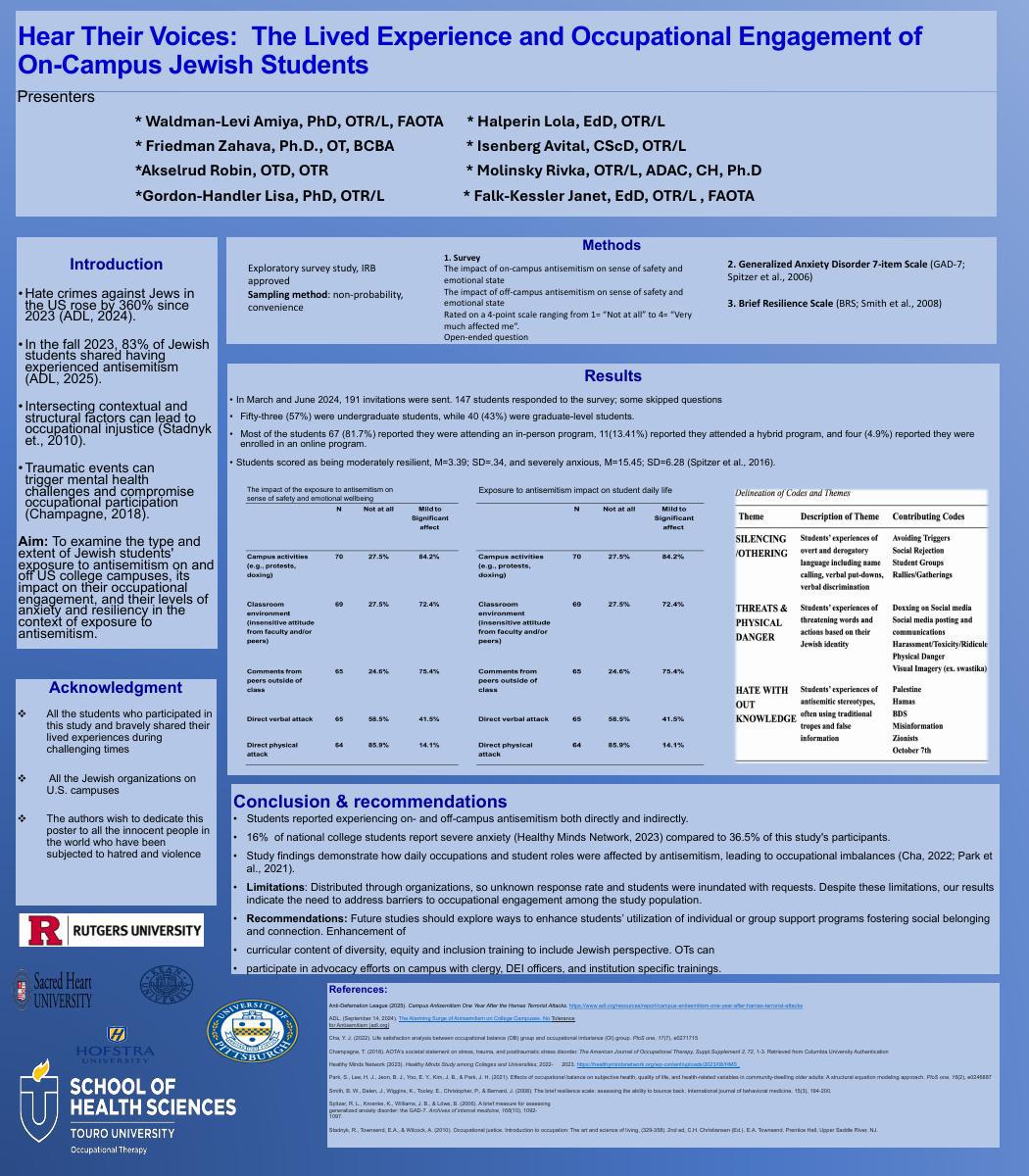
Introduction: There has been an alarming increase in antisemitism over the last ten years, culminating in the current violent nationwide antisemitic demonstrations echoing similar worldwide unrest (Wright et al., 2021; Wright et al., 2023). Despite clear evidence of Jewish college students’ exposure to antisemitism, there is a knowledge gap regarding the extent and impact of antisemitism on their mental health and occupational engagement.
Objective: To explore Jewish students' exposure to antisemitism across United States college campuses as well as the perceived impact on their occupational engagement and mental health.
Methods: A descriptive survey study was conducted, via convenience sampling of students, 18 yrs. and older who identified as Jewish and enrolled in an undergraduate/graduate program. Flyers were distributed through Jewish student organizations across US colleges. Consenting students completed a set of survey questions, the Generalized Anxiety Disorder 7-item scale (GAD-7), and the Brief Resilience Scale (BRS) in Qualtrics XM.
Results: 114 students participated. Fifty five percent of the participants reported direct experiences and 59% reported bystander experiences with antisemitism. Eighty-two percent of students reported that on-campus activities impacted their sense of safety and emotional wellbeing. Students reported that exposure to antisemitism impacted their leisure engagement (71%), social participation (65%), and completing school assignments (58%). Students reported increased anxiety (M=15; SD=6.12) and moderate resilience (M=3.36; SD=0.33).
Conclusion: Through an occupational justice lens, occupational therapy practitioners have the distinct expertise to address the impact of antisemitism on students' occupational engagement, while advocating for a safer higher education environment.