
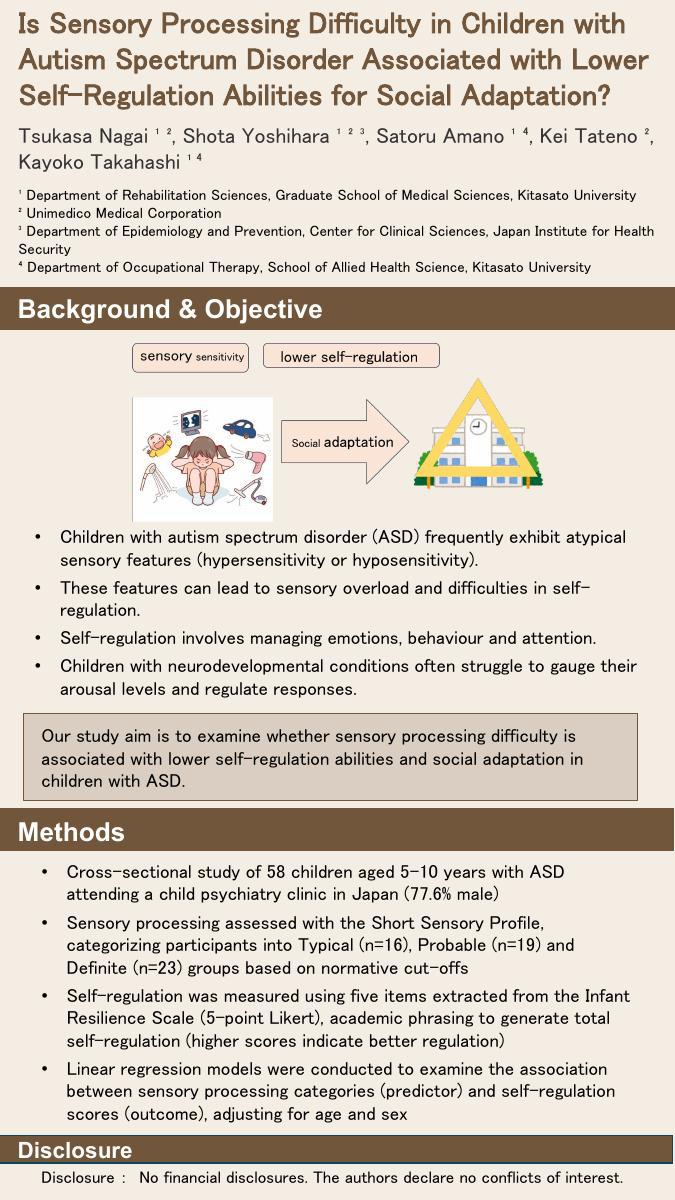
Introduction: Children with autism spectrum disorder (ASD) frequently exhibit atypical sensory features, which are common symptoms of the condition. While sensory processing abilities and self-regulation abilities often interact in these children, the relationship between these factors remains underexplored.
Objectives: We examine the association between sensory processing abilities and self-regulation abilities among children with ASD.
Methods: This cross-sectional study included children with ASD, aged 5 to 10 years, at a child psychiatry clinic in Japan. Sensory processing abilities were assessed using the Short Sensory Profile (Dunn, 1999), with participants categorized into three groups: “Typical,” “Probable,” and “Definite,” based on the scale’s cutoff scores. Self-regulation was evaluated using five items from the Japan-specific Infant Resilience Scale (Nagao, 2008) on a 5-point Likert scale, with total self-regulation scores calculated by summing the item scores (higher scores indicate greater self-regulation). Linear regression models, adjusted for age and gender, were used to investigate the association.
Results: A total of 58 children with ASD (mean age: 8.4 ±1.2 years; 77.6 % male) were included. A significant negative trend in self-regulation scores was observed with increasing sensory processing difficulties (P for trend < 0.01), as the mean self-regulation score decreased from -0.11 (95% CI: -1.96 to 1.73) in the “Probable” group to -2.33 (95% CI: -3.95 to -0.71) in the “Definite” group, compared to the “Typical” group (reference).
Conclusion: Our findings highlight the need for targeted interventions addressing sensory processing difficulties to enhance self-regulation in children with ASD.