
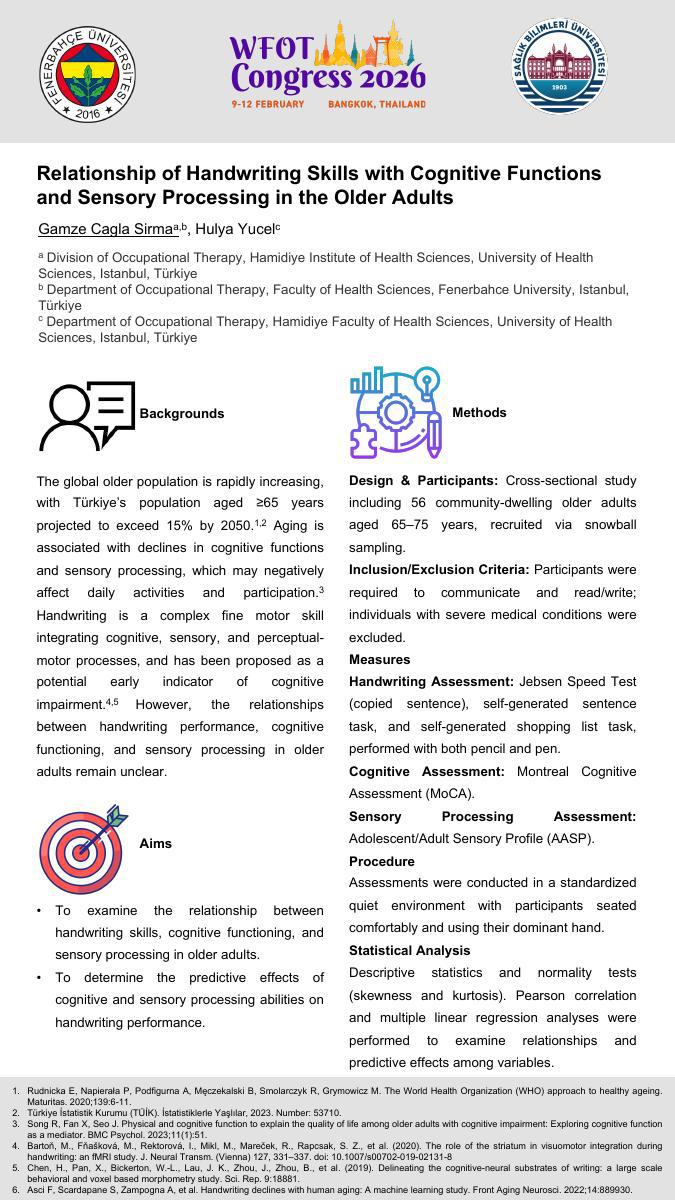
Introduction: Handwriting is a complex process requiring the integration of cognitive, sensory, and motor functions. Aging affects cognitive functioning and sensory processing, which in turn impacts daily activities, including handwriting. Although handwriting assessments have been used for early detection of cognitive decline, the relationship between handwriting, cognitive functioning, and sensory processing in older adults remains unclear.
Objectives: The aim of this study is to investigate the relationship between cognitive function and sensory processing with handwriting skills in older adults.
Methods: This study included 56 healthy community-dwelling individuals aged between 65 and 75 years. All participants completed a socio-demographic questionnaire, the Adolescent/Adult Sensory Profile, the Montreal Cognitive Assessment (MoCA), and handwriting skill performance tasks. Pearson correlation analysis was used to assess the relationship between the scores of cognitive function, sensory processing, and handwriting skill.
Results: The mean age of the participants was 70.62±3.49 years, and 53.6% of them were men. They had minimal cognitive impairment. The strongest correlations were observed between MoCA and the self-generated shopping list subtest using a pencil (r =-0.460, p<0.01) and a pen (r =-0.387, p<0.01). Low registration, sensory sensitivity, and sensation avoidance were positively correlated with handwriting subtests. The results showed that cognitive functions and sensory processing were related to older adults' handwriting skills, and these skills were also predictive of older adults' handwriting skills (p < 0.05).
Conclusion: Integrating handwriting evaluations into clinical practice offers a cost-effective, practical approach to detecting cognitive and sensory decline. These insights enhance the capacity of occupational therapists to develop preventive strategies and interventions, supporting older adults in maintaining functional independence.