
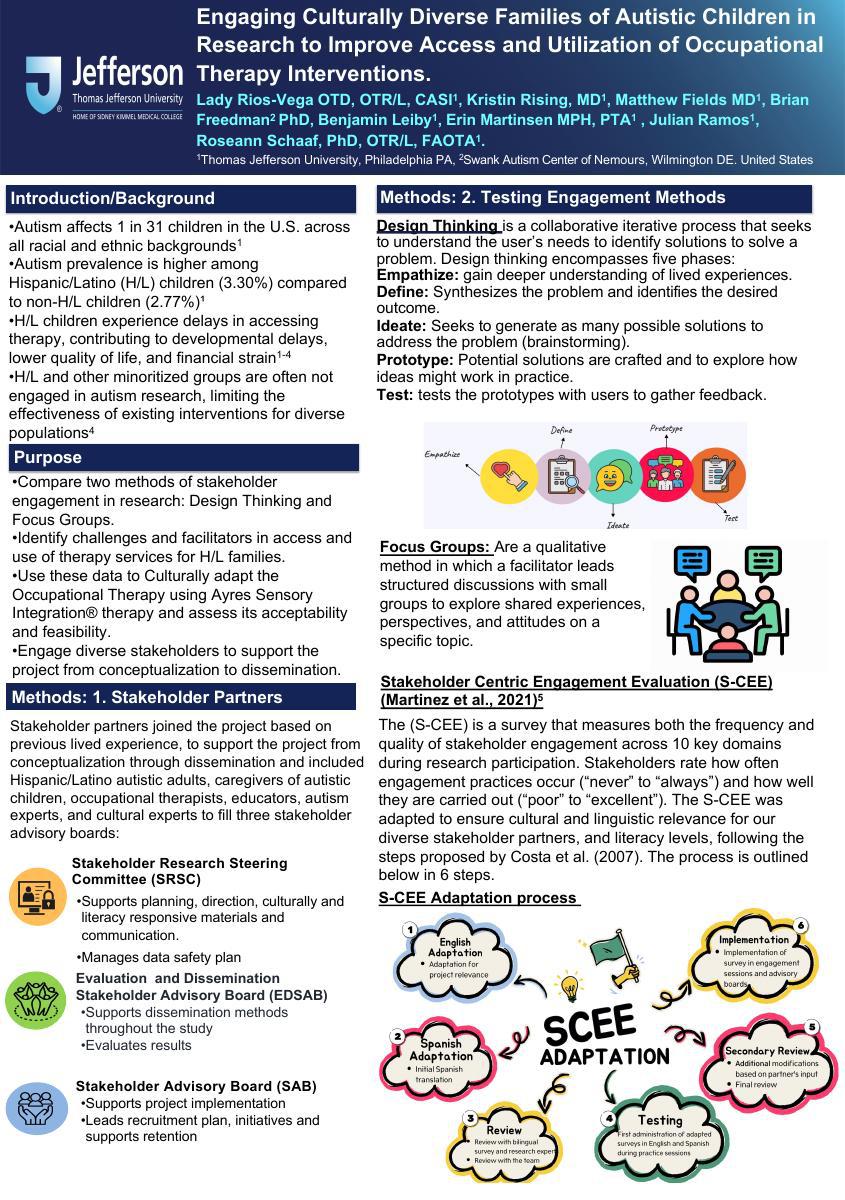
Introduction/Rationale: Minoritized families of autistic children face significant delays in accessing interventions resulting in developmental delays, lower quality of life, and economic burden. They are also underrepresented in research. Stakeholder engagement in research improves cultural relevance, inclusion, outcomes, and utilization of interventions.
Objectives: We present new data from a larger community engagement project that establishes stakeholder boards and evaluates their engagement satisfaction and quality.
Objectives:
- Establish advisory boards that represent diverse stakeholders
- Evaluate stakeholder engagement and acceptability of activities.
Methods/Approach: We used a mixed methods prospective design and snowball sampling to recruit Hispanic and Latino (H/L) stakeholders. Engagement activities included learning modules to familiarize stakeholders with project concepts. Acceptability was measured using the Acceptability of Intervention Measure (AIM) and engagement using the Stakeholder-Centric Engagement Evaluation. Measures use a Likert scale where 5 = always/excellent/completely agree and 1 = never/poor/completely disagree.
Results/Practice Implications: Three stakeholder advisory boards were formed to guide the project from conceptualization to dissemination (n = 22). Stakeholders included H/L caregivers of autistic individuals (n = 7), autistic individuals (n=3), H/L cultural experts (n=3), occupational therapists (n=3), autism experts (n=3), and teachers (n=3). Each board is culturally and racially diverse and represents varied backgrounds.
Eighty-three percent of stakeholders found the learning modules were acceptable and useful. Engagement was rated highly with means of 4.5/50 (SD=0.24) and 4.29/5 (SD=0.23).
Conclusion/Contribution to therapy profession: We successfully established diverse stakeholder boards that rated the engagement process highly. Engagement can improve access, cultural relevance and utilization of occupational therapy interventions, and inclusion of minoritized communities in research.