
A. Introduction
The symptoms of pneumonia can be mild or severe. Occupational therapists play a important role in the recovery from the deconditioning status after suffering the pneumonia by applying problem-solving skills and methods such as splinting fabrication, upper and lower extremity training for activity of daily living and energy conservation strategies. The resistive exercise focused on improving muscle strength, endurance and cardiorespiratory stamina, and leading to increase the participation for tasks in daily living.
B. Objectives
The purpose of this study is to improve the performance of activity of daily living for clients with pneumonia after tracheostomy in nursing home.
C. Methods
We arranged two clients with tracheostomy suffering from the pneumonia living in the nursing home to participate the occupational therapy course twice a week, consisting the resistive exercise and education for the activity of daily living. We applied the Barthel Index(BI), and Motor Activity Log(MAL) to assess their functional recovery at initial and follow-up evaluation.
D. Results
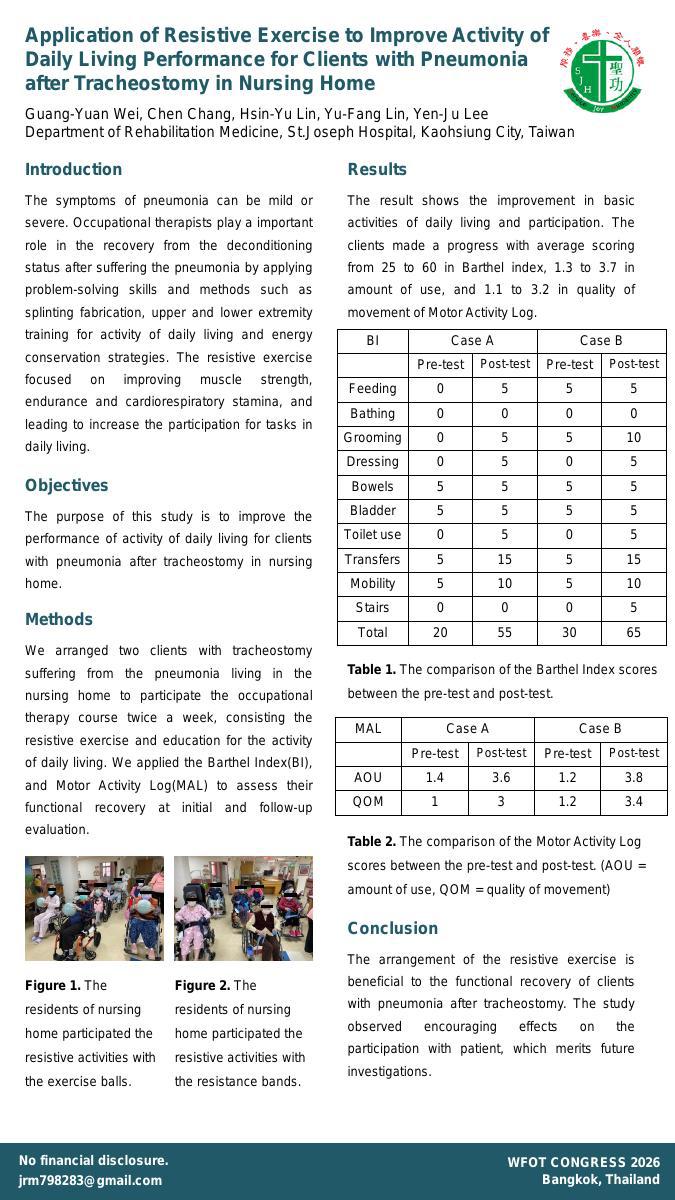
The result shows the improvement in basic activities of daily living and participation. The clients made a progress with average scoring from 25 to 60 in BI, 1.3 to 3.7 in amount of use, and 1.1 to 3.2 in quality of movement of MAL.
E. Conclusion
The arrangement of the resistive exercise is beneficial to the functional recovery of clients with pneumonia after tracheostomy. The study observed encouraging effects on the participation with patient, which merits future investigations.