
A. Introduction
Sensory integration has been a theoretical framework for treating disabilities in children with sensory integration dysfunction(SID). Children with SID may have difficulties in regulating sensory input and discriminating external sensations, motor symptoms(e.g. poor coordination and limited planning and sequencing motor skills) and social isolation or withdraw. Development of visual perception and discrimination is complicated, and it relies coordination of the head and eyes, scanning, sensory and information processing. Mandarin phonetic symbols are connected with recognition of words and arranged in the curriculums among the preschoolers in Taiwan.
B. Objectives
The purpose of this study is to improve the visual-perception performance of the children with sensory integration dysfunction.
C. Methods
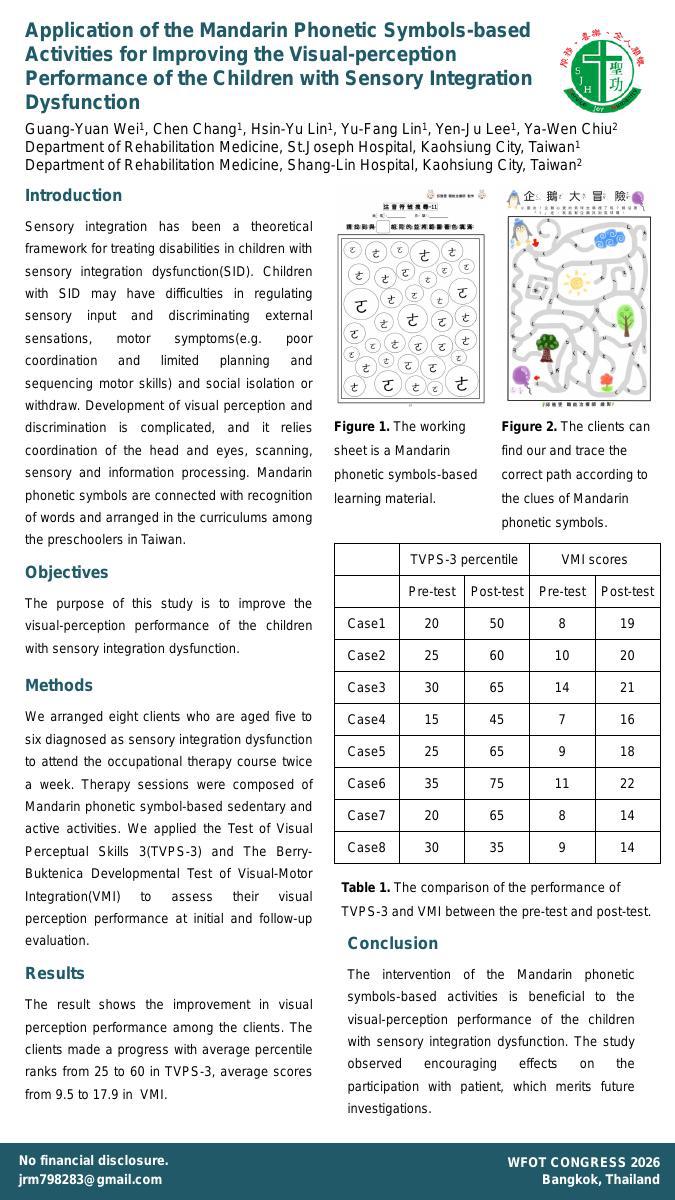
We arranged eight clients who are aged five to six diagnosed as sensory integration dysfunction to attend the occupational therapy course twice a week. Therapy sessions were composed of Mandarin phonetic symbol-based sedentary and active activities. We applied the Test of Visual Perceptual Skills 3(TVPS-3) and The Berry-Buktenica Developmental Test of Visual-Motor Integration(VMI) to assess their visual perception performance at initial and follow-up evaluation.
D. Results
The result shows the improvement in visual perception performance among the clients. The clients made a progress with average percentile ranks from 25 to 60 in TVPS-3, average scores from 9.5 to 17.9 in VMI.
E. Conclusion
The intervention of the Mandarin phonetic symbols-based activities is beneficial to the visual-perception performance of the children with sensory integration dysfunction. The study observed encouraging effects on the participation with patient, which merits future investigations.