
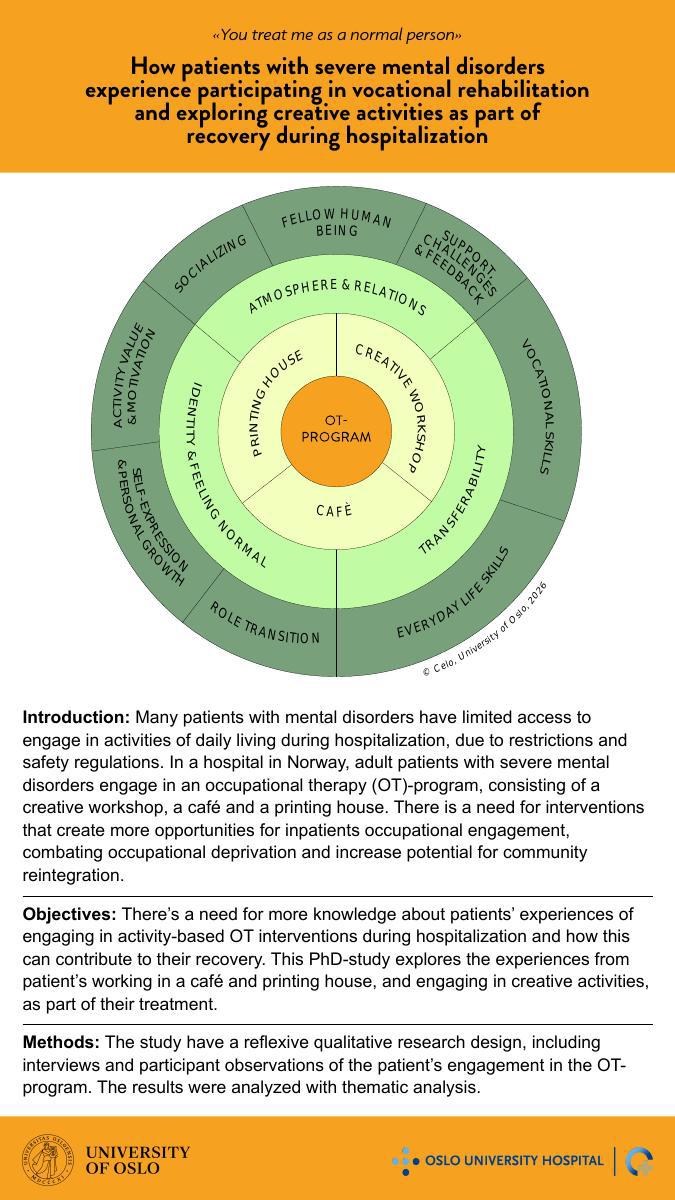
Introduction: Many patients with mental disorders have limited access to engage in activities of daily living during hospitalization, due to restrictions and safety regulations. In a hospital in Norway, adult patients with severe mental disorders engage in an occupational therapy (OT)-program, consisting of a creative workshop, a café and a printing house. There is a need for interventions that create more opportunities for inpatients occupational engagement, combating occupational deprivation and increase potential for community reintegration.
Objectives: There’s a need for more knowledge about patients' experiences of engaging in activity-based OT interventions during hospitalization and how this can contribute to their recovery. This PhD-study explores the experiences from patient’s working in a café and printing house, and engaging in creative activities, as part of their treatment.
Methods: The study have a qualitative research design, including interviews and participant observations of the patient’s engagement in the OT-program. The results were analyzed with thematic analysis.
Results: Four themes emerged. Normality, shifting from a passive patient role to contributing and feeling more normal. Meaningfulness, experiencing motivation to participate, and the impact on their sense of identity. Relation, experiencing connection as fellow human beings with the OTs, and the importance of the social arena. Transferability, developing everyday life skills and vocational skills that can be applied after discharge.
Contribution to the Occupational Therapy Profession: The knowledge will contribute to a better understanding of what can be important in patients' recovery processes from a client-centered perspective.