
【Introduction】
The Grade-4/5 Motor Activity Log (MAL) was developed by Taub et al. (2013) as an evaluation method to quantify the frequency of use and quality of movement of the affected arm in real-life situations for severe hemiparetic stroke patients.
【Objectives】
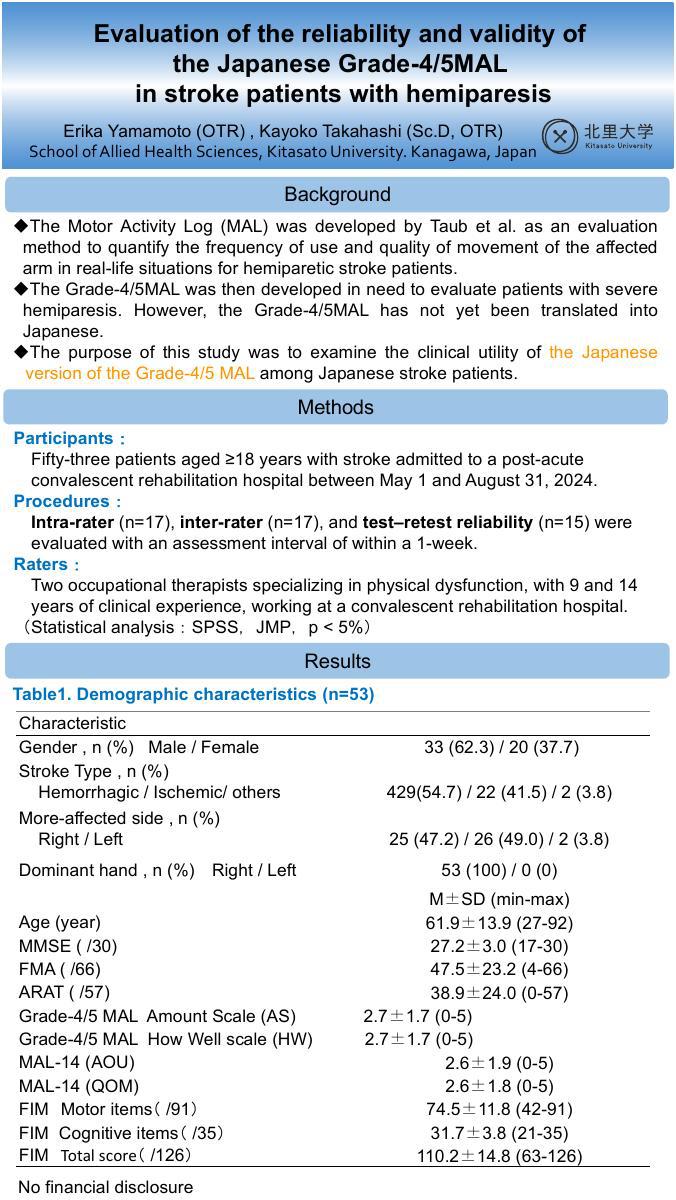
The purpose of this study was to evaluate reliability and validity of the Japanese version of the Grade-4/5 MAL.
【Methods】
Fifty-three stroke patients were recruited. Clinical utility was evaluated by examining reliability through intra-rater (ICC [1,2]), inter-rater (ICC [2,1]), test-retest (ICC [2,1]) reliability and internal consistency (Cronbach's alpha) for the Amount Scale (AS) and How Well Scale (HW). Criterion-related validity was assessed through Pearson’s correlation with MAL-14, while construct validity was evaluated using Spearman’s correlation with MMSE, FMA, ARAT, FIM, sensory function.
【Results】
The Japanese Grade-4/5 MAL demonstrated high reliability: intra-rater reliability (AS: 0.994, HW: 0.994), inter-rater reliability (AS: 0.991, HW: 0.992), and test-retest reliability (AS: 0.989, HW: 0.987). Internal consistency was also high (AS: 0.965, HW: 0.962). Criterion-related validity with MAL-14 showed significant strong correlations. Construct validity revealed strong correlations with FMA, ARAT, and FIM motor scores, while moderate correlations were observed with FIM cognitive scores. No significant correlation was found with MMSE or sensory function.
【Conclusion】
The Japanese Grade-4/5 MAL exhibited excellent reliability and validity, and these findings holds significant potential for clinical application.