
Introduction:Collaborating with clients from diverse cultural backgrounds is necessary to occupational therapists, making the development of cultural competency (CC), defined by Deardorff (2006) as "behaving and communicating appropriately and effectively in intercultural situations," essential in higher education. However, the effect of international exchange programs on CC of Occupational Therapy (OT) students remains underexplored.
Objectives: This study investigated whether an international exchange program within the OT curriculum enhance CC among Japanese OT students.
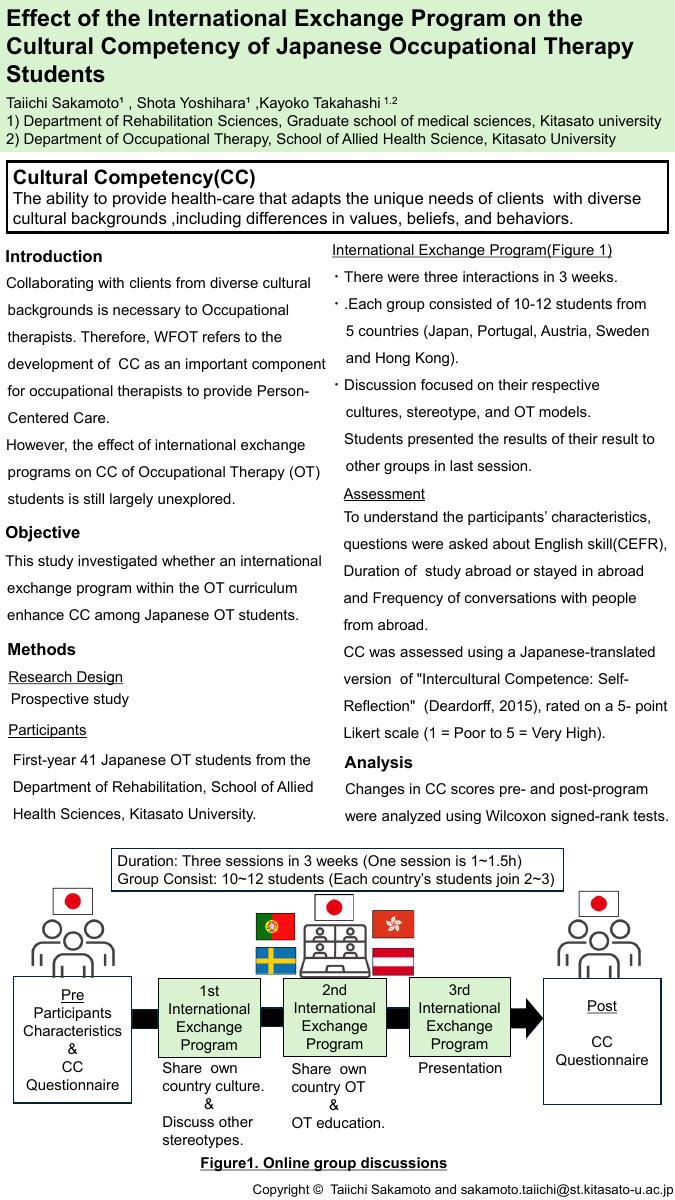
Methods: Forty-one Japanese OT students participated in 3 online group discussions. Each group consisted of 8 students from 5 countries (Japan, Portugal, Austria, Sweden and Hong Kong). Discussion focused on their respective cultures, healthcare systems, and OT models. CC was assessed using a Japanese-translated version of the 15-item "Intercultural Competence: Self-Reflection" scale (Deardorff), rated on a 5-point Likert scale (1 = Poor to 5 = Very High). Changes in CC scores pre- and post-program were analyzed using paired t-tests and Wilcoxon signed-rank tests.
Results: There was no significant change in total CC scores (mean change: 1.22 ± 7.19, p = 0.28). However, significant improvement was reported in the subscale "Withholding judgment" (mean change: 0.32 ± 0.11, p < 0.05), while "Communication skills" declined significantly (mean change: -0.39 ± 1.12, p < 0.05).
Conclusion: The international exchange programs did not significantly enhance overall CC but showed potential for improving specific skills like "Withholding judgment." The decline in "Communication skills" may indicate increased awareness of linguistic challenges. Future programs should integrate language support and tailored interventions to enhance CC.