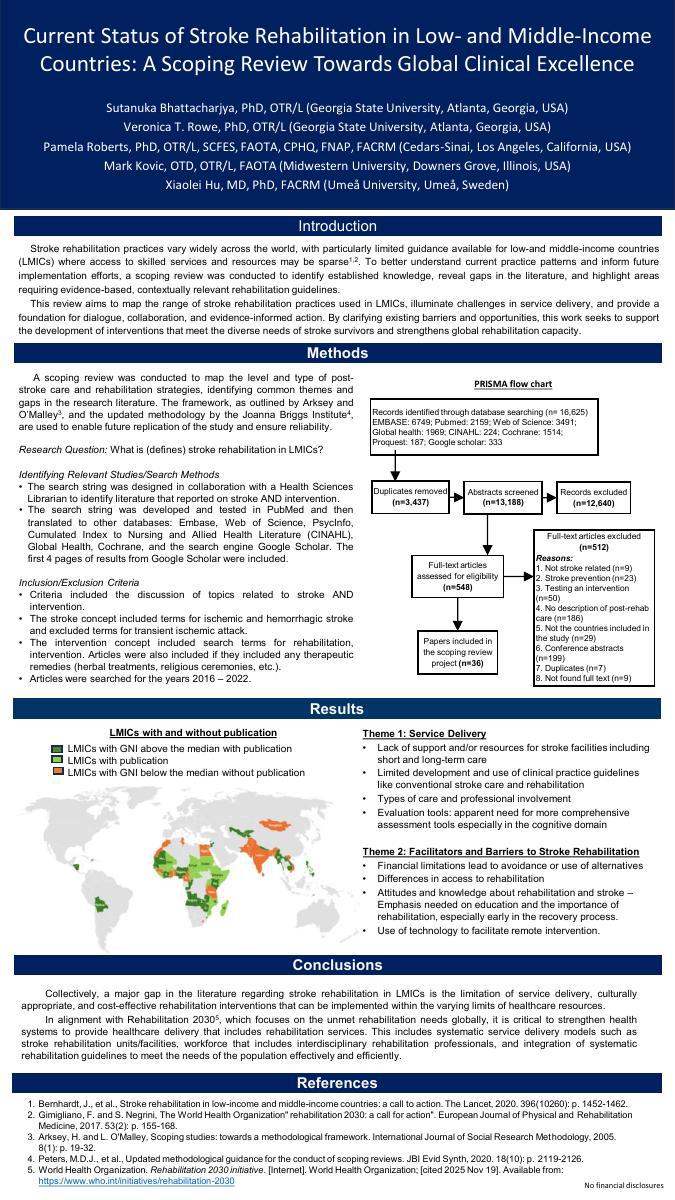
Introduction: Stroke incidence, prevalence, mortality, and disability-adjusted life years have grown rapidly in low- and middle-income countries (LMICs) compared to high-income countries. In accordance with the World Health Organization’s 2030 agenda, focus is for equitable access to rehabilitation services on a global scale, especially LMICs. A step is to understand the current status of stroke care in LMICs.
Objectives: Through a scoping review, the authors sought to explore, understand, and identify the current practice and service delivery of stroke rehabilitation in LMICs.
Methods: Search strings were constructed for 8 databases to include relevant terms for stroke and intervention including rehabilitation, and complementary and integrative remedies. Utilizing the Rayyan platform, 5 blinded reviewers screened 16,625 abstracts followed by 151 full texts using a list of inclusion/exclusion criteria.
Results: Thirty-six articles were included in this study. Out of the 51 LMICs, only 17 countries (33%) were represented. Two themes emerged from this scoping review. The first theme of service delivery addressed limited stroke units/facilities, various unofficial guidelines, type of care with uni-professional involvement as well as some evaluation tools. The second theme of facilitators and barriers to stroke rehabilitation focused on financial limitations, attitudes and knowledge, and technology.
Conclusion: A major gap in the literature regarding stroke rehabilitation in LMICs is the limitation of service delivery.Cost-effective rehabilitation interventions that can be implemented within the varying limits of healthcare resources. In alignment with the Rehabilitation 2030 agenda for unmet needs for rehabilitation globally, it is critical to strengthen healthcare delivery systems that include systematic service delivery models including stroke rehabilitation units/facilities, a workforce of interdisciplinary rehabilitation professionals, and integration of systematic rehabilitation guidelines.
