
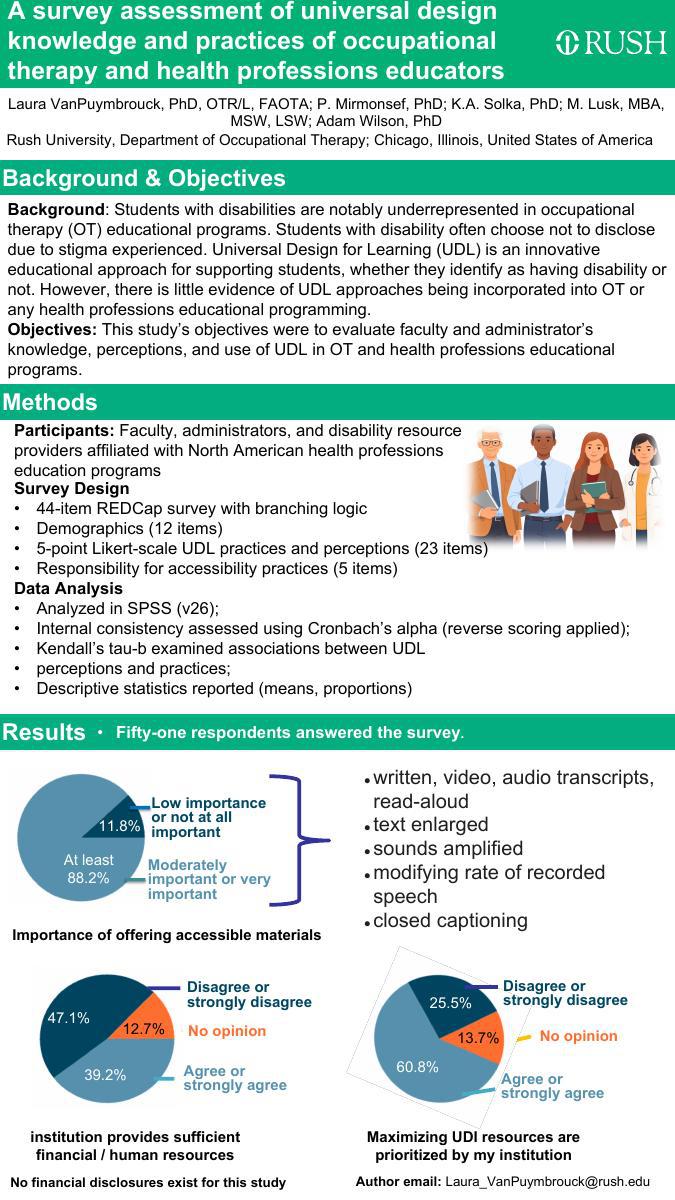
Introduction/Rationale: Students with disabilities are notably underrepresented in occupational therapy (OT) educational programs. Universal Design for Learning (UDL) is an innovative educational approach for supporting students, whether they identify as having disability or not. However, there is little evidence of UDL approaches being incorporated into OT or any health professions educational programming.
Objectives: This study’s objectives were to evaluate faculty and administrator’s knowledge, perceptions, and use of UDL in OT and health professions educational programs.
Methods/Approach: REDCap software distributed a 44-item 5-point Likert scale survey to professional listservs. Cronbach’s alpha and Kendall’s tau b were used in analysis.
Results/Practice Implications: Fifty-one participants completed the survey, the majority OTs (22) . At least (88.2%; 45/51) of respondents indicated it was important/very important to give students access to information using different modalities, adjustable formats, and assistive technologies. Over half (54.9%; 28/51) of respondents indicated faculty are primarily responsible for ensuring access to UDL resources. However, 80.4% (41/51) indicated faculty workload is a barrier to maximize UDL resources. Many (60.8%; 31/51) agreed/strongly agreed maximizing UDL resources are prioritized by their institutions, but only 39.2% (20/51) agreed/strongly agreed their institution provided sufficient financial/human resources. Educators recognize UDL’s value but there are institutional barriers in the form of workload, limited knowledge and resources that create barriers to UDL methods being implemented.
Conclusion / Contribution to the occupational therapy profession: Results suggest disparities between the interest for, versus institutional support of, UDL resources. This underscores the need for OT and health professions programming to explore opportunities to support implementation of UDL principals within curricula.