
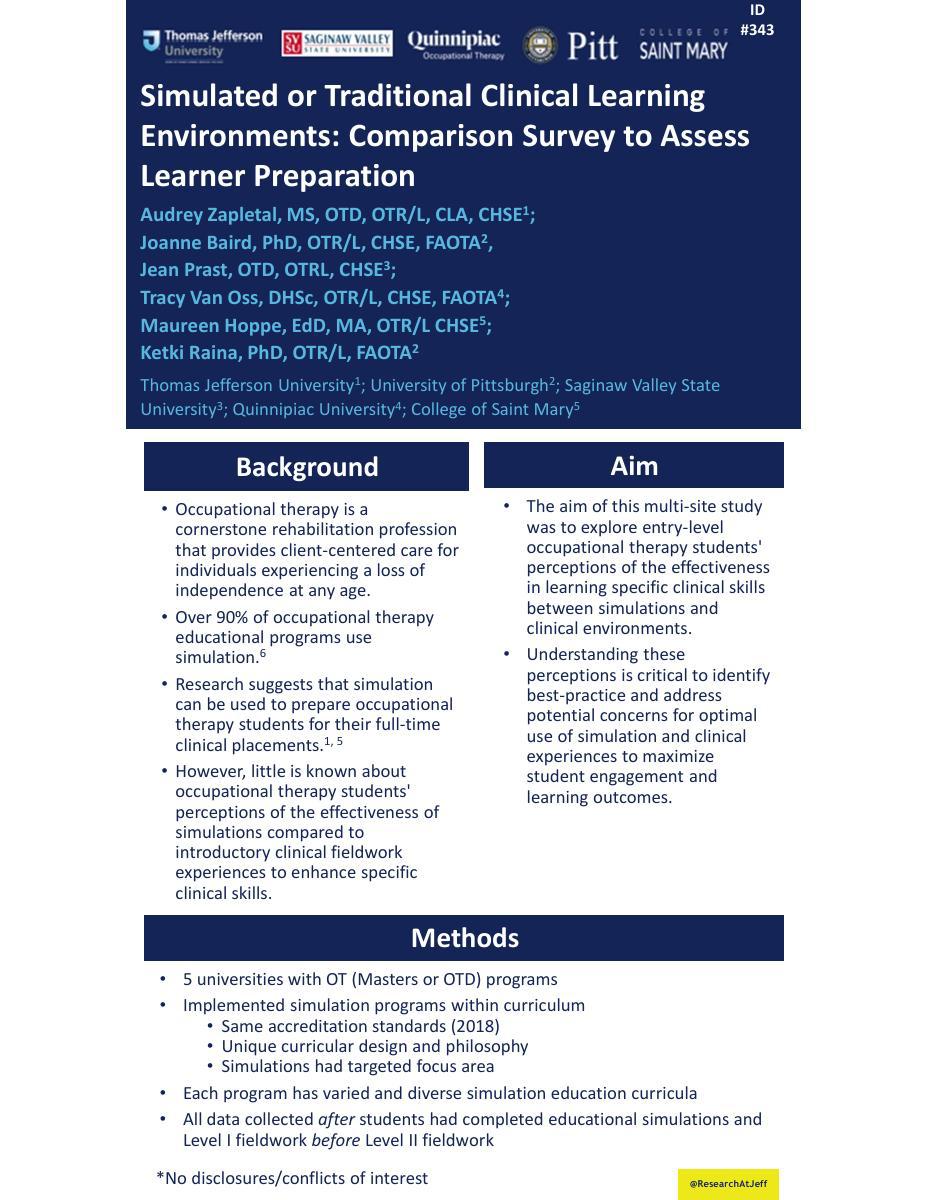
Introduction / Rationale: This research investigates perceptions of entry-level occupational therapy students regarding the effectiveness of simulations compared to clinical environments for skill development utilizing the Clinical Learning Environment Comparison Survey (CLECS) to analyze responses from 460 students across five educational institutions.
Objective:To evaluate students’ perceptions of the effectiveness of simulation versus traditional clinical environments in learning clinical skills.
Methods / Approach: This retrospective survey compared student learning experiences in traditional and simulated environments using the CLECS. The CLECS evaluates six subscales: holism, teaching-learning dyad, communication, therapy process, self-efficacy, and critical thinking. The survey was administered once to students from five U.S. occupational therapy programs prior to Fieldwork II. Responses were de-identified and analyzed using descriptive statistics. All programs obtained IRB approval, with one institution overseeing the data use agreement (DUA).
Results / Practice Implications: Students rated clinical environments more effective than simulations for overall learning, as well as for communication, holism, critical thinking, and teaching-learning dyad subscales (p < .05). No differences were found for the occupational therapy process and self-efficacy domains. Effect sizes were small for total scale, holism, and critical thinking (Cohen’s d = 0.31–0.40) and medium for communication (Cohen’s d = 0.56).
Conclusion / Contribution: Findings indicate clinical environments are more effective for developing communication and critical thinking skills, whereas simulations excel in supporting teaching-learning interactions and offer a psychologically safe space. By aligning learning objectives with the strengths of each setting, student preparedness for professional practice can be significantly enhanced.