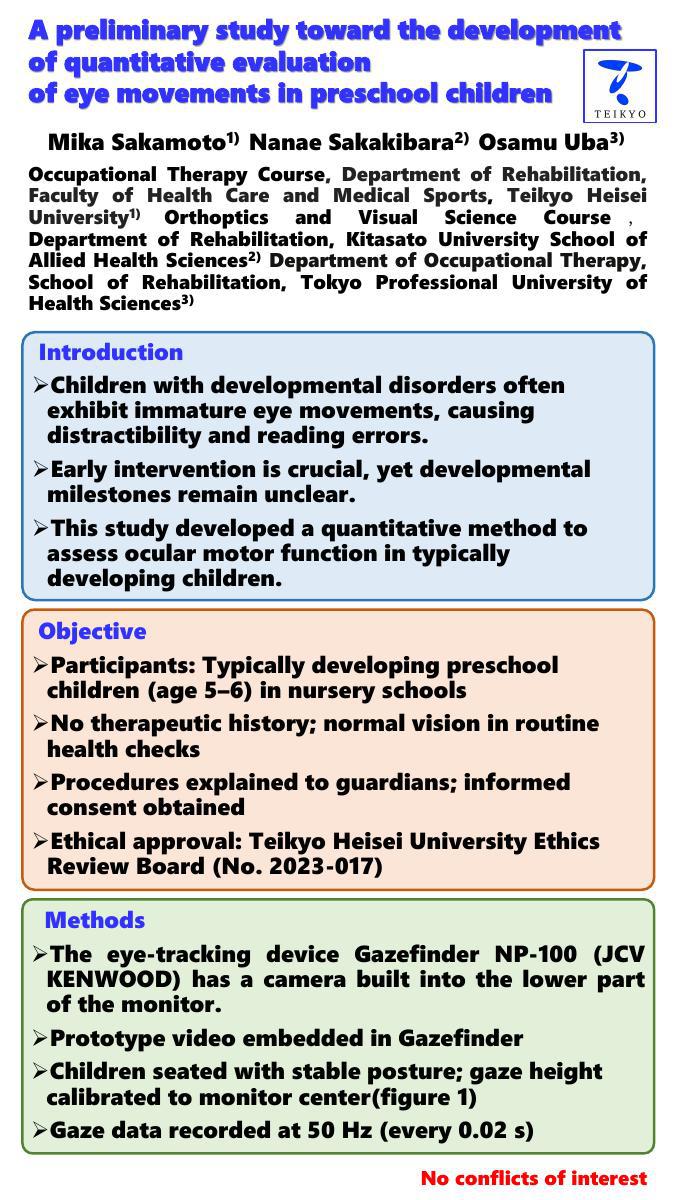
Introduction /Rationale:Children with developmental disorders often exhibit immature eye movements, which can underlie problematic behaviors. Clinically, eye movement evaluations are observational, lacking standard indicators. Objectives:This study aims to present quantitative indicators of eye movements in typically developing children to clarify abnormalities and characteristics. Methods/Approach: Stimulus presentation videos were created to induce eye movements and incorporated into the "JVC Kenwood Gazefinder NP-100" eye-tracking device. After obtaining parental consent, the eye movements of six infants were measured. The study was approved by the Ethics Review Committee of Teikyo Heisei University.
Results/Practice Implications: The six participants (two boys, four girls, aged 5 years 7 months to 6 years 2 months) had their eye movements averaged every 0.02 seconds. The proportion of gaze within 3 degrees from the fixation point was 90.8%. In the latter half of the 10-second measurement, the deviation and standard deviation of gaze position increased. Horizontal saccades showed the smallest standard deviation in the third trial, indicating quick gaze shifts. The average saccade inclusion rate in horizontal pursuit movements was 27.3%. Both horizontal saccades and pursuit movements improved with repetition.
Conclusion:The stimulus presentation video revealed difficulties in maintaining infants' attention due to the measurement length. However, repeated measurements showed a learning effect. Early-stage learning effects may be characteristic of typically developing children. Detailed adjustments to the stimulus presentation video, analysis methods, and head position considerations are required.
