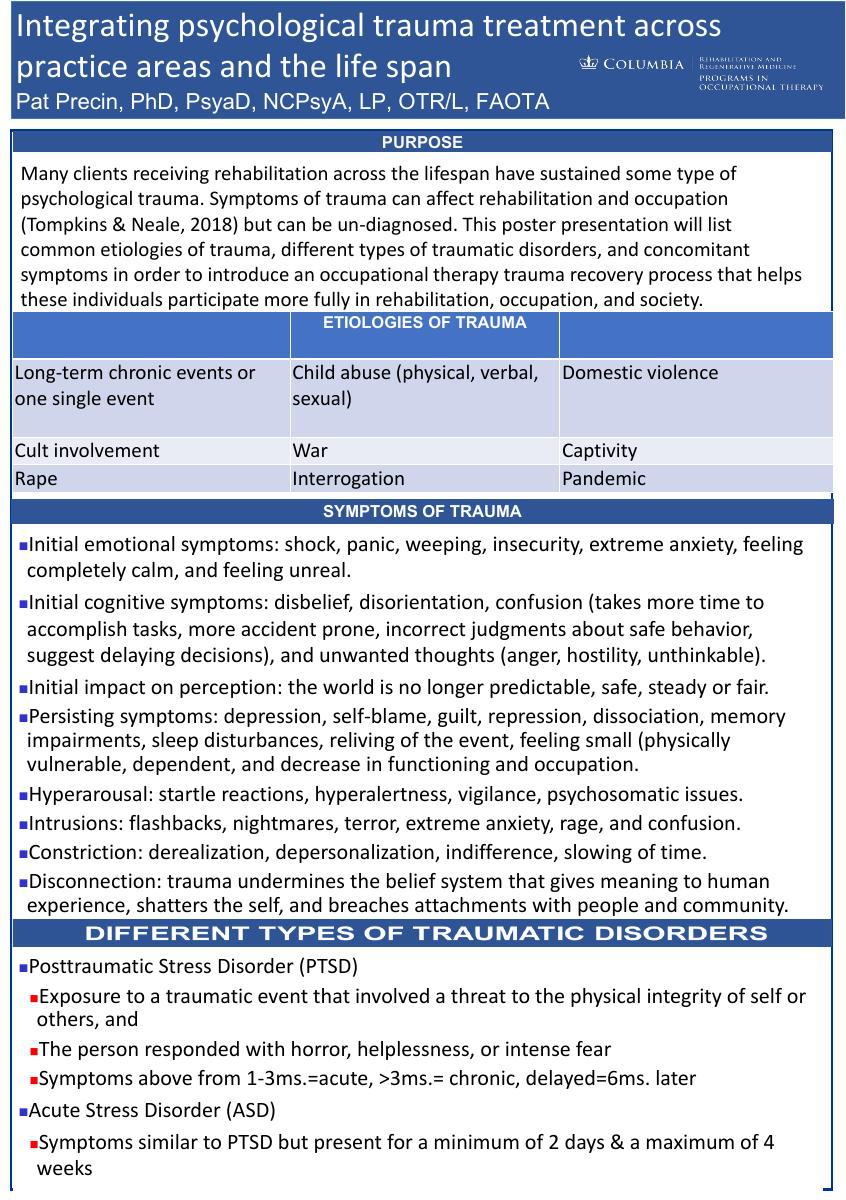
Introduction: Many clients receiving rehabilitation across the lifespan have sustained psychological trauma that can affect rehabilitation and occupation but can go undetected unless the occupational therapy practitioner has had training in symptom identification and intervention.
Objectives: Participants will be able to: list three etiologies, types, and symptoms of psychological trauma and utilize an occupational therapy trauma recovery process that helps individuals living with psychological trauma participate more fully in rehabilitation, occupation, and society.
Approach: A three-step model of trauma informed intervention (safety, recalling memories and mourning, reengagement) will be introduced along with how to develop a healing relationship without re-traumatization, what to do, what not to do, and how to deal with emotionally laden material to avoid secondary trauma when treating clients with psychological trauma.
Practical Implications: This information will aid occupational therapy practitioners in reflecting on past clients who may have suffered from trauma that affected their rehabilitation and inform treatment of future clients.
Conclusion: This poster presentation gives occupational therapy practitioners a tool for treating psychological trauma in this age of rapidly increasing global pandemics, natural disasters, political unrest, hate crimes, and separation, thus adding to the re-evolution of occupational therapy.
