
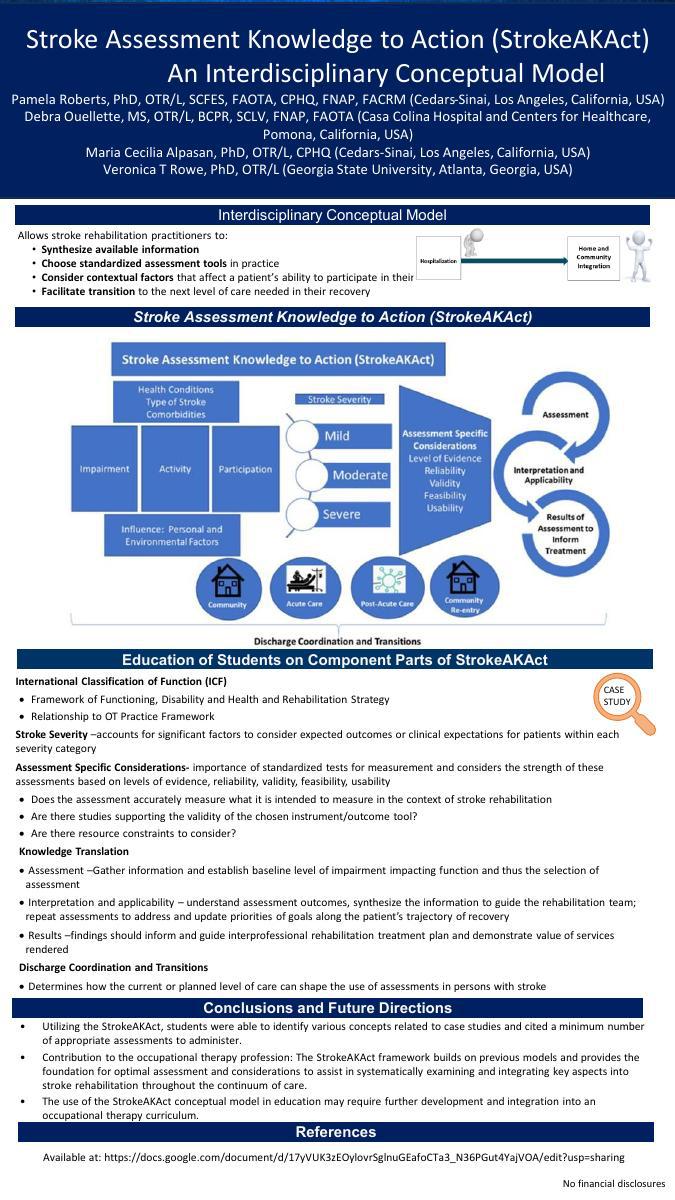
Introduction: Research within the stroke population continues to expand, offering new insights and advancements in the field. As a result, occupational therapists have a difficult time filtering through this multitude of research and determining the appropriate assessment tools for individuals with stroke through the rehabilitation continuum.
Objective: The Stroke Rehabilitation Assessment Knowledge to Action (StrokeAKAct) conceptual model is proposed to allow occupational therapists to synthesize available information and appropriately choose standardized assessment tools in practice while considering contextual factors and facilitating transition to next levels of care. The initial objective of using the StrokeAKAct was to assess the effectiveness of applying this model in educating occupational therapy students.
Approach: The StrokeAKAct uses the International Classification of Function Framework and takes into consideration stroke severity and factors affecting the choice of standardized assessments through examination of patient specific situations. Students were presented the StrokeAKAct model and asked to apply it to different case studies to identify appropriate assessments in different settings of care.
Practice Implications: The model incorporates the choice of assessment tools based on the practitioner’s workflow, with concepts being influenced by the level of care. Utilizing the StrokeAKAct, students were able to identify various concepts related to case studies and cited a minimum number of assessments appropriate to administer.
Contribution to the occupational therapy profession: The StrokeAKAct framework builds on previous models and provides the foundation for optimal assessment and considerations to assist in systematically examining and integrating key aspects into stroke rehabilitation throughout the continuum of care. The use of the StrokeAKAct conceptual model in education may require further development and integration into an occupational therapy curriculum.