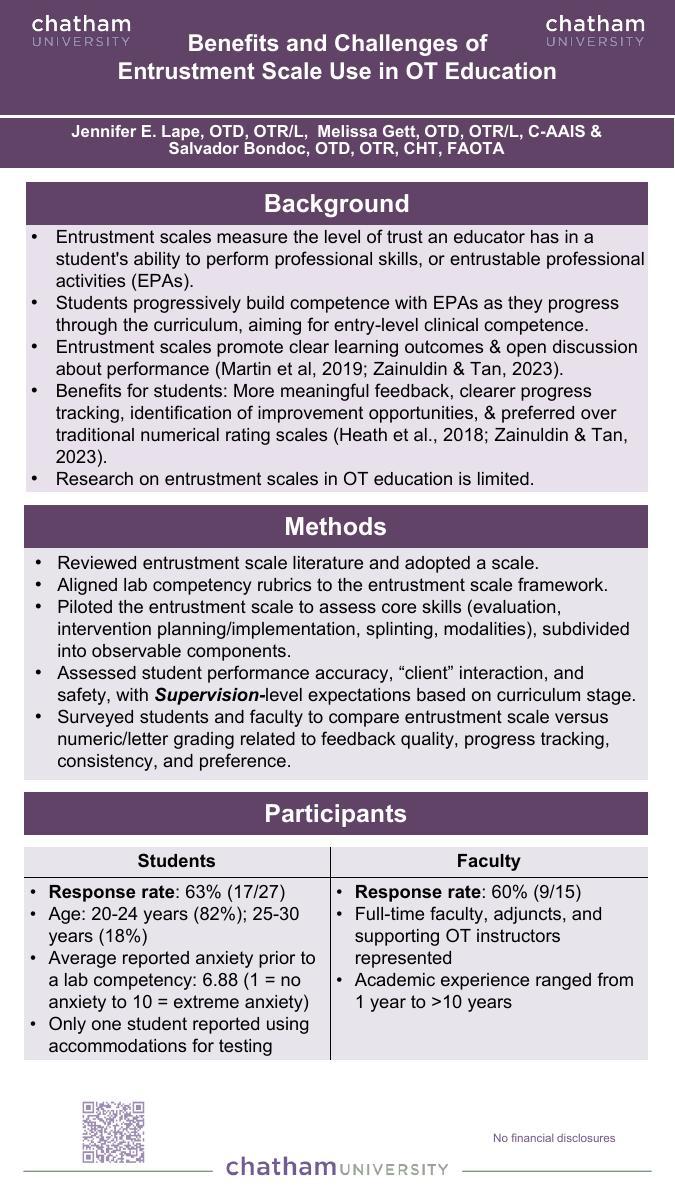
Introduction / Rationale: Entrustment scales are assessment tools that can be used to evaluate an educator’s trust in students’ ability to perform specific professional skills (entrustable professional activities or EPAs). Prior research confirms that healthcare students in other disciplines who experienced entrustment scales during their education rated the experience positively, yet the benefits and challenges in OT education remain underexplored.Objectives: To explore the perceived benefits and challenges of using entrustment scales in OT education.
Methods / Approach: Entrustment scaling was used to assess OT student performance during clinical course competencies in an entry-level OT program. Student and faculty perspectives were gathered via surveys and focus groups after the experience.
Results / Practice Implications: Eighty-two percent of students preferred entrustment scaling over numeric grading scales, citing assessment consistency, clear expectations, reduced stress, and quality of feedback as benefits. Faculty concurred with these benefits but found challenges in defining EPAs and differentiating between levels of trust on the entrustment scale. Further research in this area could support accurate assessment of student performance to better prepare entry-level occupational therapy practitioners.
Conclusion / Contribution to the occupational therapy profession: Entrustment scaling may enhance the student learning experience, but refinement of the scale and key EPAs requires further faculty development. The profession must further refine and standardize universal competencies to advance toward a competency-based education model.
