
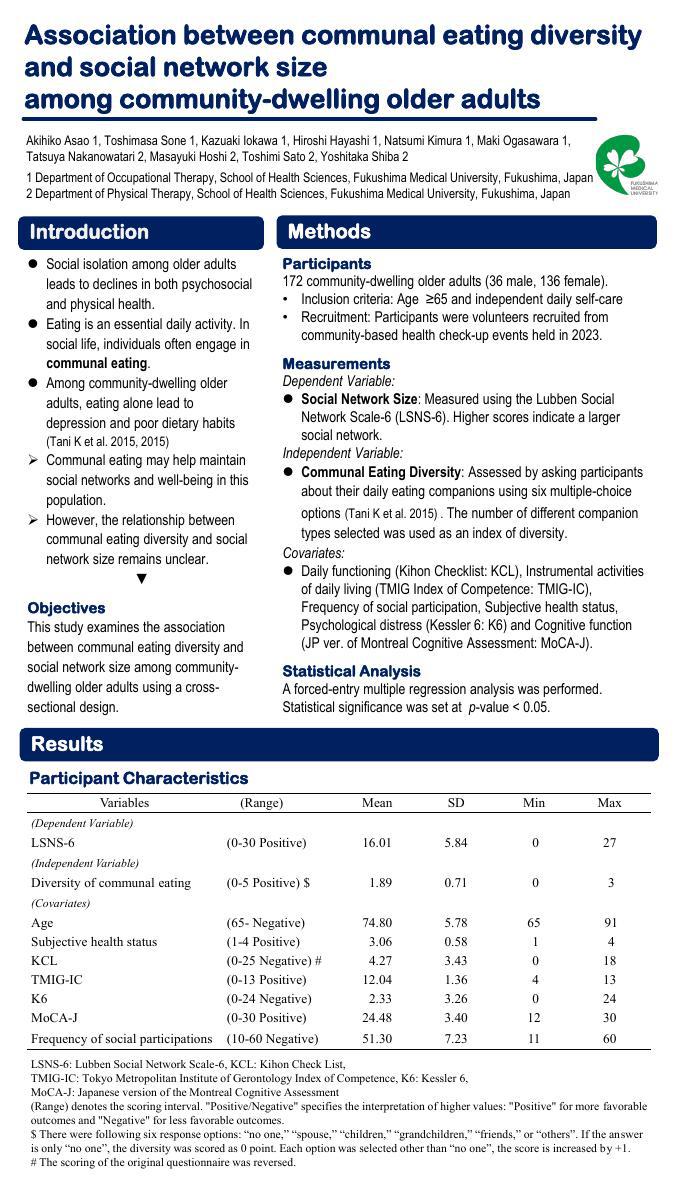
Introduction: Social isolation among older adults leads to declines in both psychosocial and physical health. Communal eating may help maintain social networks and well-being. However, the relationship between communal eating diversity and social network size remains unclear.
Objectives: This study examines the association between communal eating diversity and social network size among community-dwelling older adults using a cross-sectional design.
Methods: A total of 172 older adults, 36 male and 136 female, aged ≥65 years participated. Social networks were assessed using the Lubben Social Network Scale-6 (LSNS-6). Communal eating diversity was measured by asking participants about their daily eating companions, with six multiple-choice options. Other assessments included the Kihon Checklist for daily functioning, the Tokyo Metropolitan Institute of Gerontology Index of Competence (TMIG-IC) for instrumental activities of daily living, frequency of social participation, subjective health status, the Kessler 6 for psychological distress, and the Montreal Cognitive Assessment for cognitive function. A Multiple regression analysis with forced entry was performed, with LSNS-6 as the dependent variable and the other assessments, age, and gender as independent variables. The significance level was set at p < 0.05.
Results: The regression model was significant (Adjusted R² = 0.362). Communal eating diversity (β = 0.18), gender (β = 0.165, female), subjective health status (β = 0.18), TMIG-IC (β = 0.40), and social participation (β = 0.21) were significantly associated with LSNS-6.
Conclusion: Communal eating diversity was associated with social support networks alongside other individual factors. Future research should explore environmental influences and develop predictive models.