
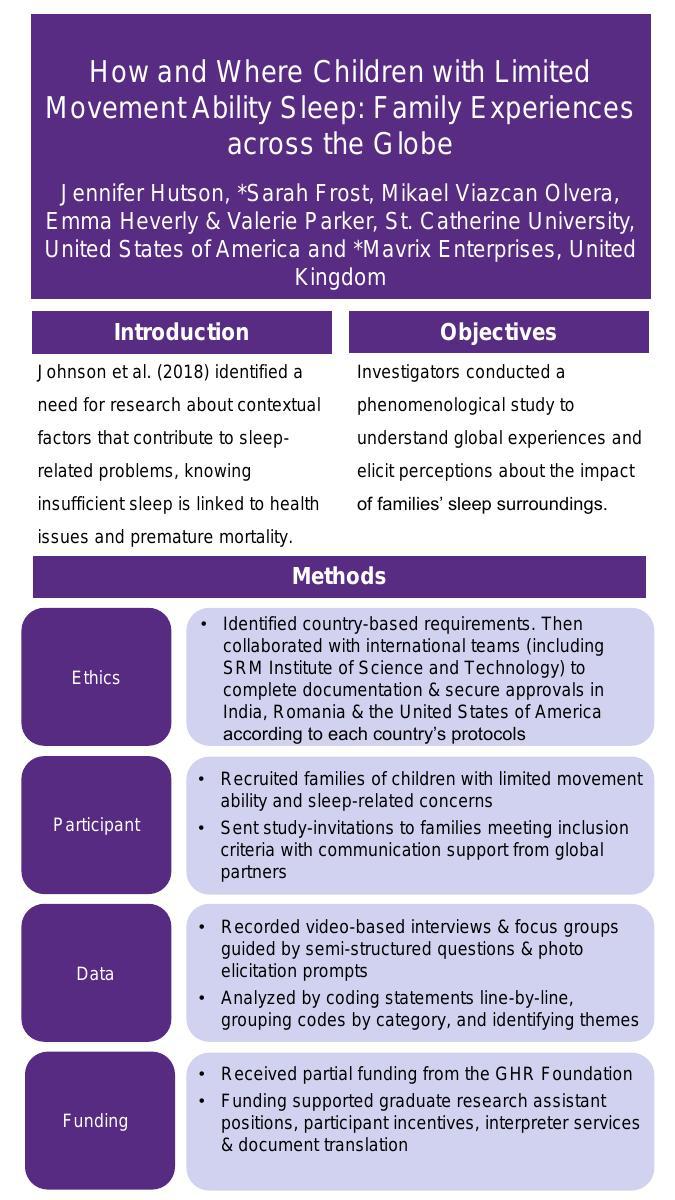
Introduction / Rationale: Insufficient sleep for individuals with limited movement is linked to health-related issues and premature mortality; yet is often overlooked by healthcare providers. Providers would benefit from understanding the impact family, household contexts, socioeconomic status, and culture have on sleep duration, quality, and satisfaction. Qualitative research can help practitioners understand these factors.
Objectives: Elicit global perspectives of children and families to understand interactions between individuals and their surroundings on sleep performance. Gather descriptions from families about their sleep context (e.g. physical, social, temporal) and perceptions of how that context affects performance.
Methods / Approach: For this phenomenological study, investigators recruited a purposive sample of individuals who met study-inclusion criteria with assistance from global contacts. Participants completed semi-structured interviews that incorporated photo elicitation followed by a focus group with participants from their same country. Interviews were video-recorded, transcribed, and coded using NVivo software. Themes were revealed using open, axial, and selective coding.
Results / Practice Implications: Children (n=3) and family members (n=16) from 5 countries (China, India, Argentina, Romania & United States of America) participated. Their descriptions provide rich detail about sleep-related contextual factors. Themes included: Not fun nights/hard when younger, bent position during sleep, routine is essential, getting comfortable and figuring safety out ourselves, and usual sleep set up and place.
Conclusion / Contribution to the occupational therapy profession: Children and families describe having to learn on their own, with little help from healthcare providers, to establish sleep-related routines and a safe sleep setup. Healthcare teams will benefit from learning about their experiences in order to better support sleep for those with health conditions known to be associated with sleep-related difficulties.