Background: Occupational therapists can use a solution-focused approach to school readiness to provide children from disadvantaged backgrounds a better foundation for learning. Access to contextually relevant knowledge and training is one of the commonly reported needs of early childhood development (ECD) teachers in low-resource settings (Smit et al. 2021). Learning on a mobile device (mLearning) presents an opportunity for co-development of accessible, affordable, and contextually relevant teacher training through participatory research methods.
Objectives To evaluate the World Café as a method to co-create culture-centred content for a teacher training curriculum.
Method: Six experts in early childhood development and 35 participants providing ECD services to children from disadvantaged backgrounds, participated in a World Café. Participants discussed their understanding of the concept of school readiness, activities they use to promote physical development, and the competencies they thought learners could develop through mLearning. Framework synthesis of all transcribed data was completed. Video format preference was determined through ranked results, and a nominal group technique was used to determine the top eight teacher competencies promoted through culture-centred mLearning content.
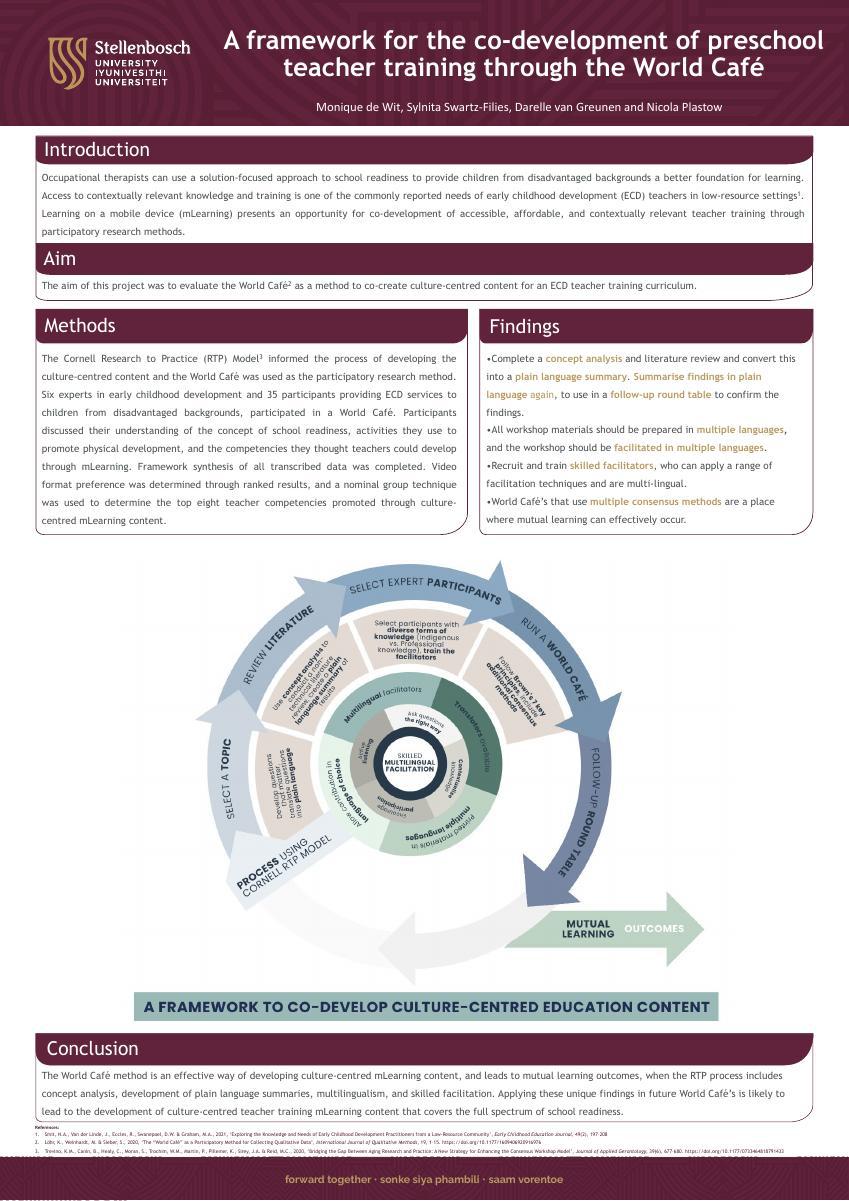
Findings: The World Café method is an effective way of developing culture-centred mLearning content, and leads to mutual learning outcomes, when the RTP process includes concept analysis, development of plain language summaries, multilingualism, and skilled facilitation.
Conclusion: Applying these unique findings in future World Café’s is likely to lead to the development of culture-centred teacher training mLearning content that covers the full spectrum of school readiness.
