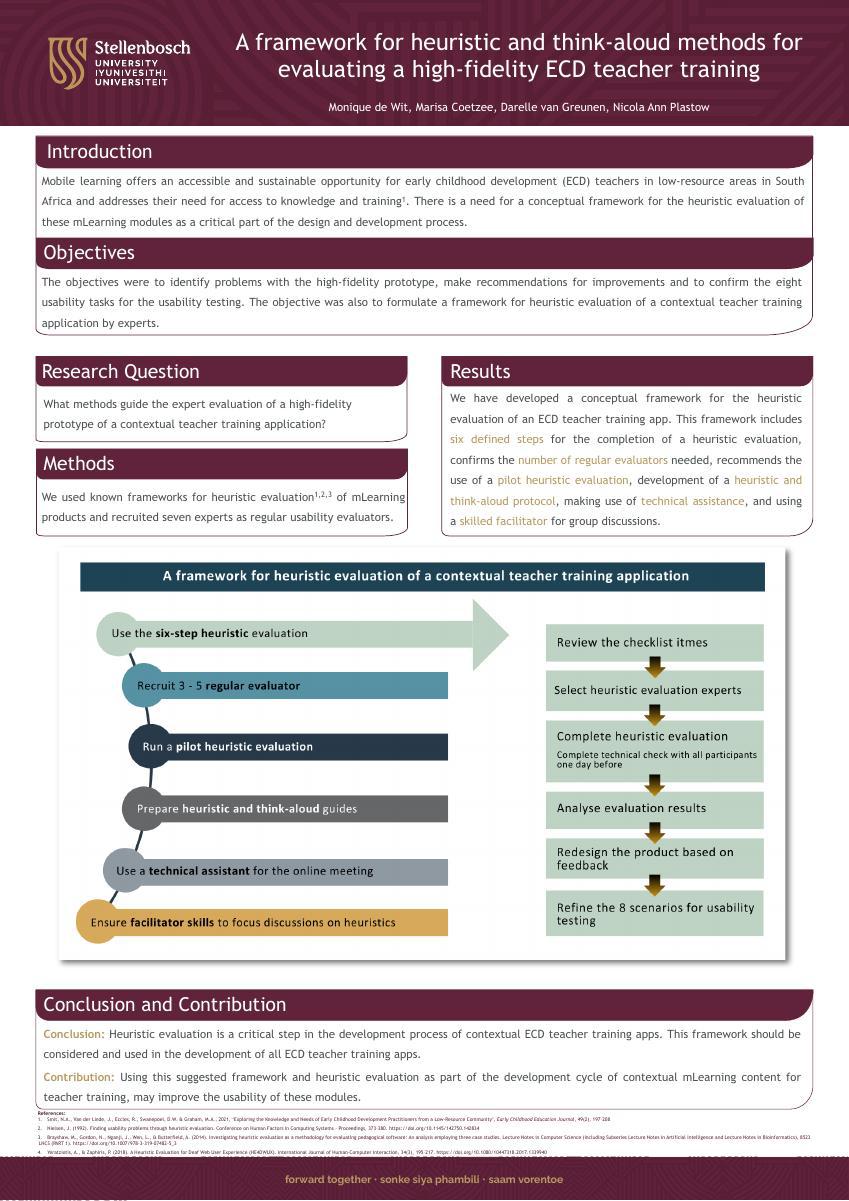
Background: Mobile learning offers an accessible and sustainable opportunity for ECD teachers in low resource areas in South Africa and address their need for access to knowledge and training. There is a need for a conceptual framework for the heuristic evaluation of these mLearning modules as a critical part of the design and development process. Objectives: The objectives were to identify problems with the high-fidelity prototype, make recommendations for improvements and to confirm the eight usability tasks for the usability testing. The objective was also to formulate a framework for heuristic evaluation of a contextual teacher training application by experts. The research question for this study is: What methods guide the expert evaluation of a high-fidelity prototype of a contextual teacher training application? Methods: We used known frameworks for heuristic evaluation of mLearning products and recruited seven experts as regular usability evaluators. Results: We have developed a conceptual framework for the heuristic evaluation of an ECD teacher training app. This framework includes six defined steps for the completion of a heuristic evaluation, confirms the number of regular evaluators needed, recommend the use of a pilot heuristic evaluation, development of a heuristic and think-aloud guide, making use of technical assistance, and using a skilled facilitator for group discussions. Conclusion: Heuristic evaluation is a critical step in the development process of contextual ECD teacher training apps. This framework should be considered and used in the development of all ECD teacher training apps. Contribution: Using this suggested framework and heuristic evaluation as part of the development cycle of contextual mLearning content for teacher training, may improve the usability of these modules.
