
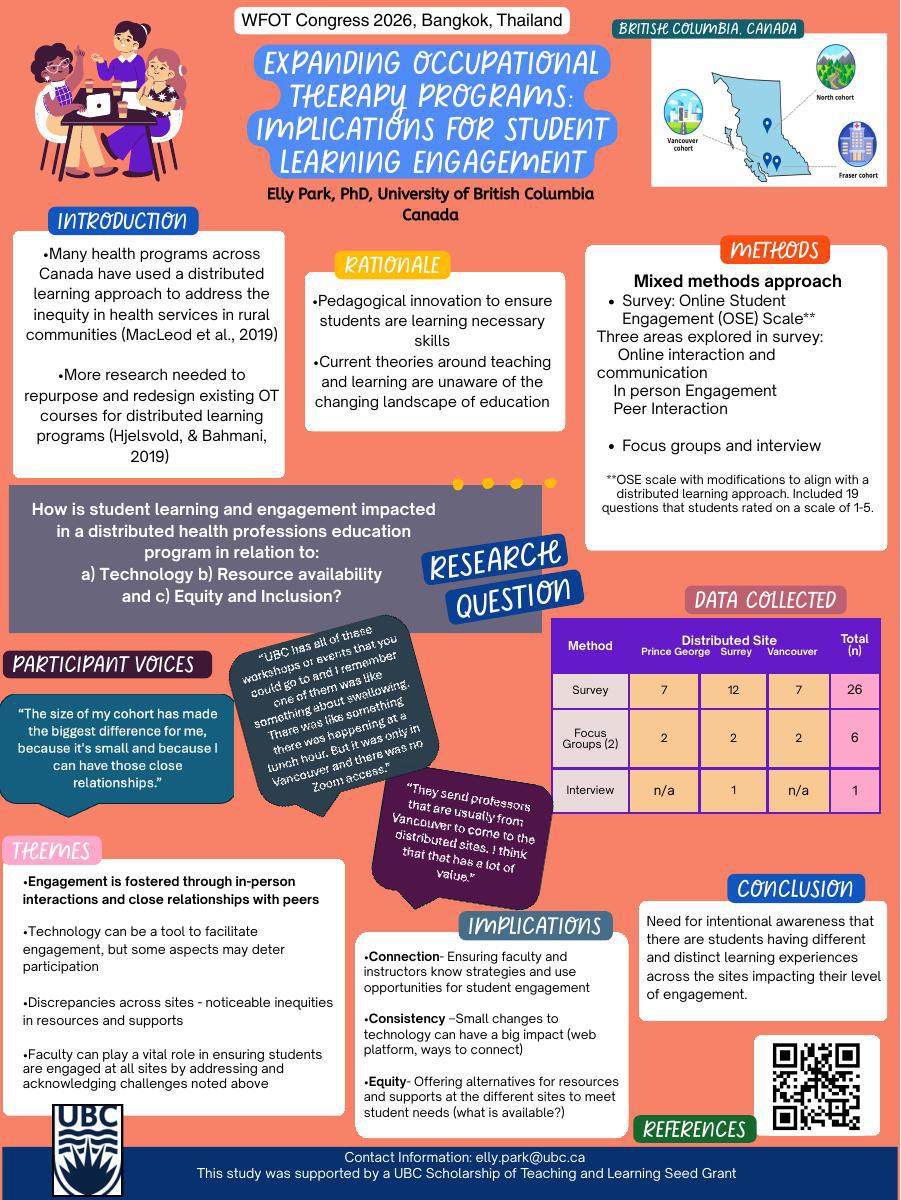
Rationale: Canadian universities have been expanding health professional education (HPE) programs by creating multiple learning sites. Described as distributed learning, this approach aims to improve access to education and address health inequities in rural communities. At one Canadian university, a two year Masters of Occupational Therapy (OT) program has recently expanded to have three distributed learning sites. With this development, we have needed to repurpose and redesign existing courses to ensure all students are learning necessary skills and competencies to become clinicians. However, we do not know how student learning and engagement is impacted by a distributed learning approach. With this knowledge, we will be better equipped to make curricular changes that effectively meet student needs.
Objectives: 1) To understand the impact of multiple learning sites on student learning and engagement, focusing on: technology, resource availability and equity and inclusion. 2) To understand how students at distributed sites are engaging in learning for skill and competency development.
Methods: A mixed-methods approach included: an on-line survey about student characteristics associated with learning engagement, and two focus groups explored student learning experiences at distributed learning sites.
Results: Survey responses (n=28) indicated participants identified with wanting to do well on assessments, being attentive in class, and being organized. Alternately, supporting peers at other distributed sites and working across sites were considered less characteristic of participants. Stories of student experiences, including feeling a sense of inequity and anxiety with technology, were captured through focus groups.
Conclusion: The need to evaluate student engagement is crucial as OT and HPE programs continue to expand using a distributed learning model nationally and internationally. We hope to develop pedagogical innovations that ensure students within a distributed program are learning necessary skills to be competent therapists.