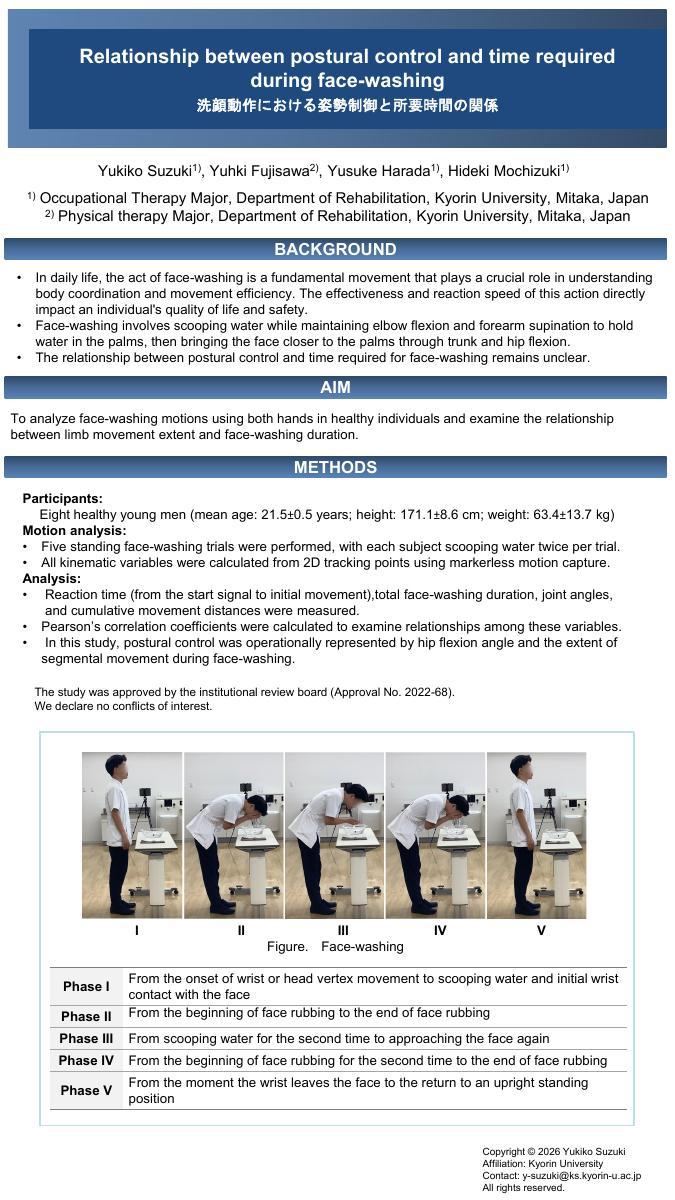
[Introduction] Face-washing involves scooping water while maintaining elbow flexion and forearm supination to hold water in the palms, then bringing the face closer to the palms through trunk and hip flexion. Although a routine daily activity, the relationship between postural control and time required for face-washing remains unclear. [Objectives] To analyze face-washing motions using both hands in healthy individuals and examine the relationship between limb movement extent and face-washing duration. [Methods] Eight healthy young men (mean age: 21.5±0.5 years; height: 171.1±8.6 cm; weight: 63.4±13.7 kg) performed five standing face-washing trials, scooping water twice per trial. Reaction time (from the start signal to initial movement), total face-washing duration, joint angles, and cumulative movement distances were measured. The study was approved by the institutional review board (Approval No. 2022-68), with no conflicts of interest. [Results] Hip flexion angle during the first face-rubbing motion was negatively correlated with reaction time (r=–0.749), indicating that greater hip flexion was associated with faster movement initiation. Conversely, the cumulative movement distances of the head, acromion, wrist, and trochanter were positively correlated with reaction time (r=0.816–0.879). Additionally, hip flexion when bringing the face closer (r=–0.742) and during the second face-rubbing motion (r=–0.726) were negatively correlated with total face-washing duration, suggesting that increased hip flexion contributed to faster task completion. [Conclusion] In standing face-washing movements among healthy men, a smaller range of motion in major upper and lower limb joints and the head, was associated with a shorter reaction time. Greater hip flexion may contribute to a shorter face-washing duration. These findings suggest that maintaining a stable flexed trunk posture improves reaction speed and movement efficiency.
