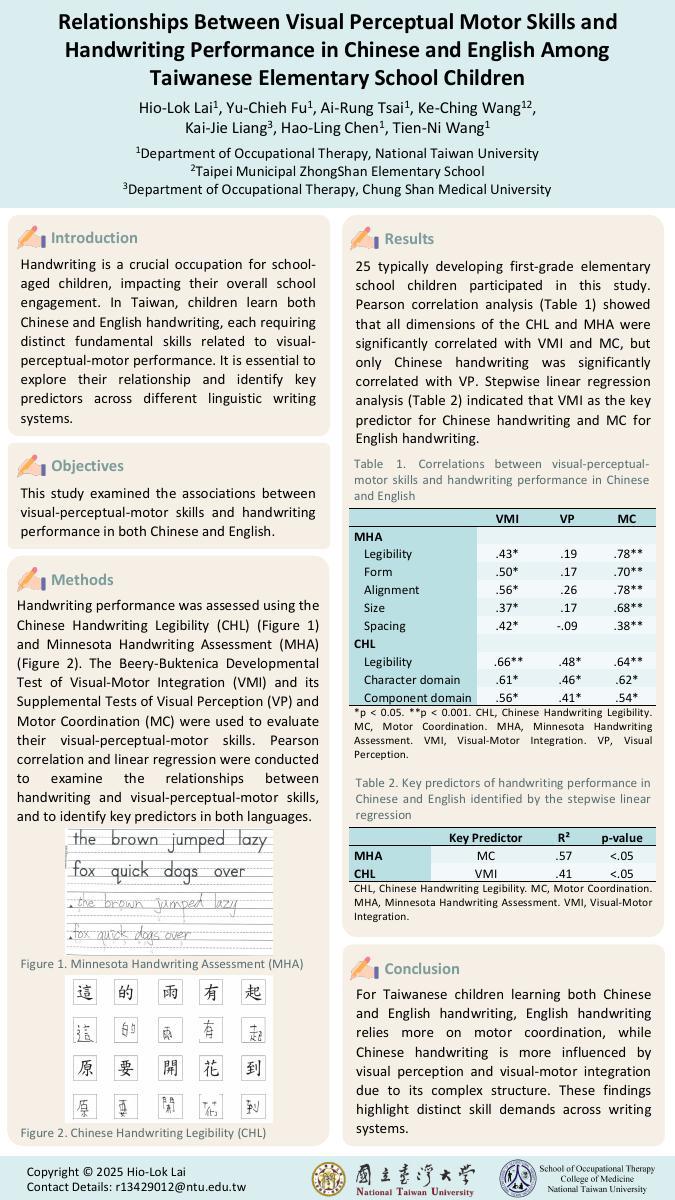
Introduction: Handwriting is a crucial occupation for school-aged children, impacting their overall school engagement. In Taiwan, children learn both Chinese and English handwriting, each requiring distinct fundamental skills related to visual-perceptual-motor performance. It is essential to explore their relationship and identify key predictors across different linguistic writing systems.
Objectives: This study examined the associations between visual-perceptual-motor skills (visual-motor integration, visual perception, motor coordination) and handwriting performance in both Chinese and English.
Methods: Handwriting performance was assessed using the Chinese Handwriting Legibility (CHL) and Minnesota Handwriting Assessment (MHA). The Beery-Buktenica Developmental Test of Visual-Motor Integration (VMI) and its Supplemental Tests of Visual Perception (VP) and Motor Coordination (MC) were used to evaluate their visual-perceptual-motor skills. Pearson correlation and linear regression were conducted to examine the relationships between handwriting and visual-perceptual-motor skills, and to identify key predictors in both languages.
Results: 25 typically developing first-grade elementary school children participated in this study. Pearson correlation analysis showed that all dimensions of the CHL and MHA were significantly correlated with VMI (r=.42-.66, ps<.05) and MC (r=.54-.78, ps<.05), but only Chinese handwriting was significantly correlated with VP (r=.41-.47, ps<.05). Stepwise linear regression analysis indicated that VMI as the key predictor for Chinese handwriting (R2=.41, ps<.05) and MC for English handwriting (R2=.57, ps<.05).
Conclusion: For Taiwanese children learning both Chinese and English handwriting, English handwriting relies more on motor coordination, while Chinese handwriting is more influenced by visual perception and visual-motor integration due to its complex structure. These findings highlight distinct skill demands across writing systems.
