
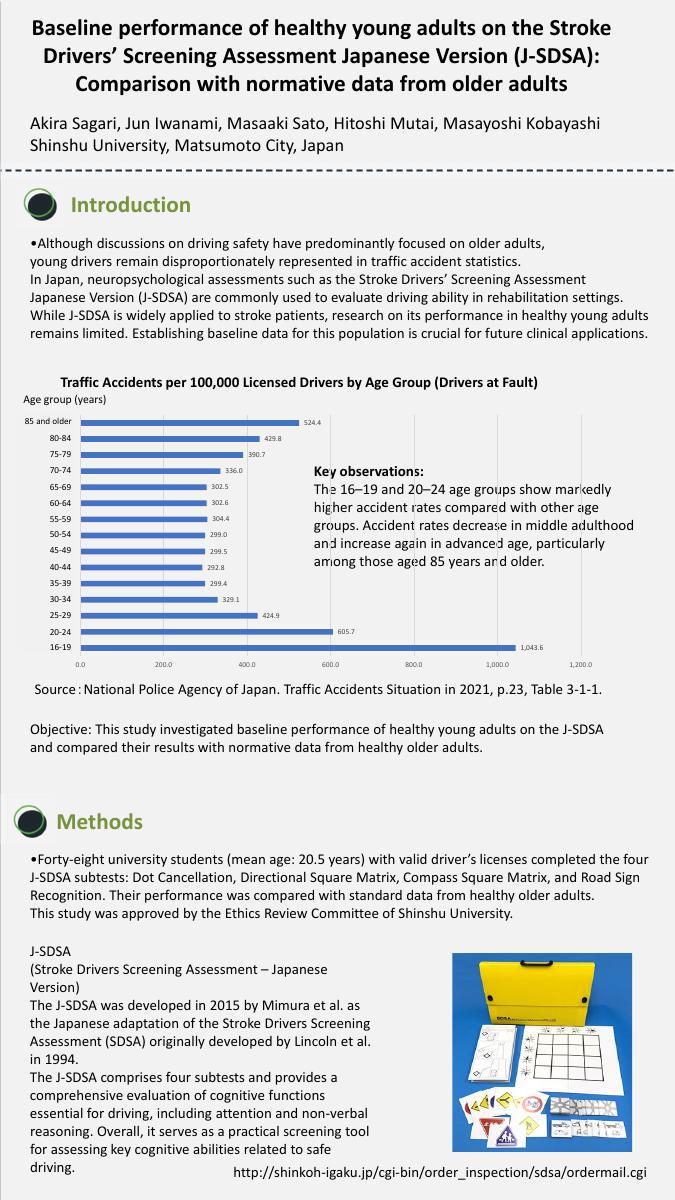
Introduction: Discussions on driving safety often focus on older adults, yet young drivers also account for a significant number of traffic accidents. In Japan, neuropsychological assessments such as the Stroke Drivers’ Screening Assessment Japanese Version (J-SDSA) are commonly used to evaluate driving ability in rehabilitation settings. While J-SDSA is widely applied to stroke patients, research on its performance in young adults remains limited. Establishing baseline data for this population is crucial for future clinical applications.
Objectives: This study aimed to examine the performance characteristics of healthy young adults on the J-SDSA and compare their results with normative data for healthy older adults provided in the test manual.
Methods: Forty-eight healthy young adults (mean age: 20.5 years) with valid driver’s licenses completed the four J-SDSA subtests: Dot Cancellation, Directional Square Matrix, Compass Square Matrix, and Road Sign Recognition. Their performance was compared with standard data from healthy older adults. This study was approved by the ethics review committee of our university.
Results: Young adults demonstrated superior performance to older adults in all subtests. The largest performance differences were observed in Dot Cancellation, Directional Square Matrix, and Compass Square Matrix, while the gap was smaller in Road Sign Recognition. All participants were classified as "fit to drive" based on J-SDSA scoring criteria.
Conclusion: This discrepancy further supports the idea that age-related cognitive differences influence J-SDSA performance, particularly in tasks requiring attention and spatial cognition. This study provides foundational data on J-SDSA performance in healthy young adults, emphasizing the importance of age-related norms in occupational therapy-based driving rehabilitation. We believe that these findings may be useful for determining driving eligibility in young adults.