
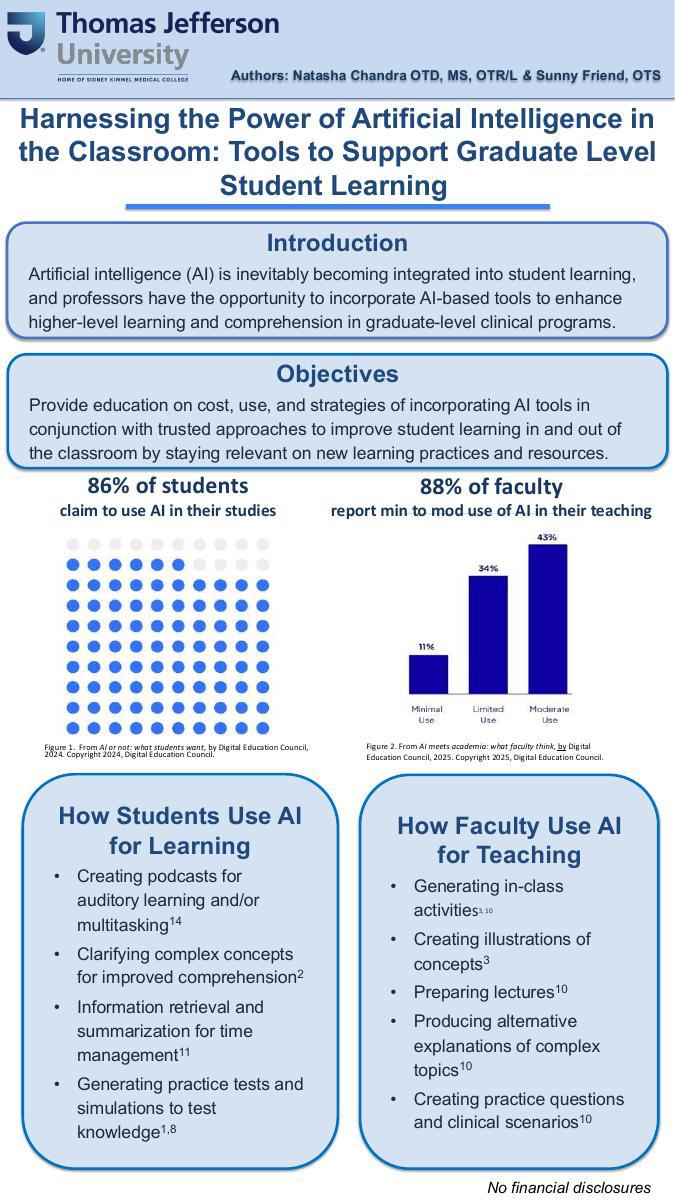
Introduction: Artificial intelligence (AI) is inevitably becoming integrated into student learning, and professors have the opportunity to incorporate AI-based tools to enhance higher-level learning and comprehension in graduate-level clinical programs.
Objectives: Provide education on cost, use and strategies of incorporating AI tools in conjunction with trusted approaches to improve student learning in and out of the classroom by staying relevant on new learning practices and resources.
Approach: Presentation of AI tools, their capabilities and cost, and demonstrations of potential clinical implementation opportunities provides instructors with the base knowledge to incorporate this into an assignment, course or curriculum. Knowledge translation with other faculty members and students can then be utilized in an individualized fashion that meets student and university needs.
Practice Implications: As AI technology grows in clinical practice, it is important to demonstrate ethical and practical use of it. In this case, the focus is on providing the best education for students to grow their competence, skills, and clinical reasoning for the occupational therapy profession. By incorporating these tools, students could use AI technology for feedback on their comprehension of complex subjects and return to the classroom with a greater understanding of clinical concepts.
Conclusion: The benefits of AI-tools are just being explored from a professorial and pedagogical perspective. These tools give students more opportunities for feedback beyond professors while enhancing their self-learning abilities in a graduate level program. Rolling with the tides of technological advancement puts current and future practitioners at an advantage of being comfortable with new technologies.