Introduction: Low daily living skills post-discharge heighten the risk of problematic behavior and re-hospitalization in forensic patients. It remains unclear if ongoing group occupational therapy (OT) enhances these skills.
Objective: To determine whether high Involvement in group OT for forensic patients with schizophrenia enhances daily living skills at discharge.
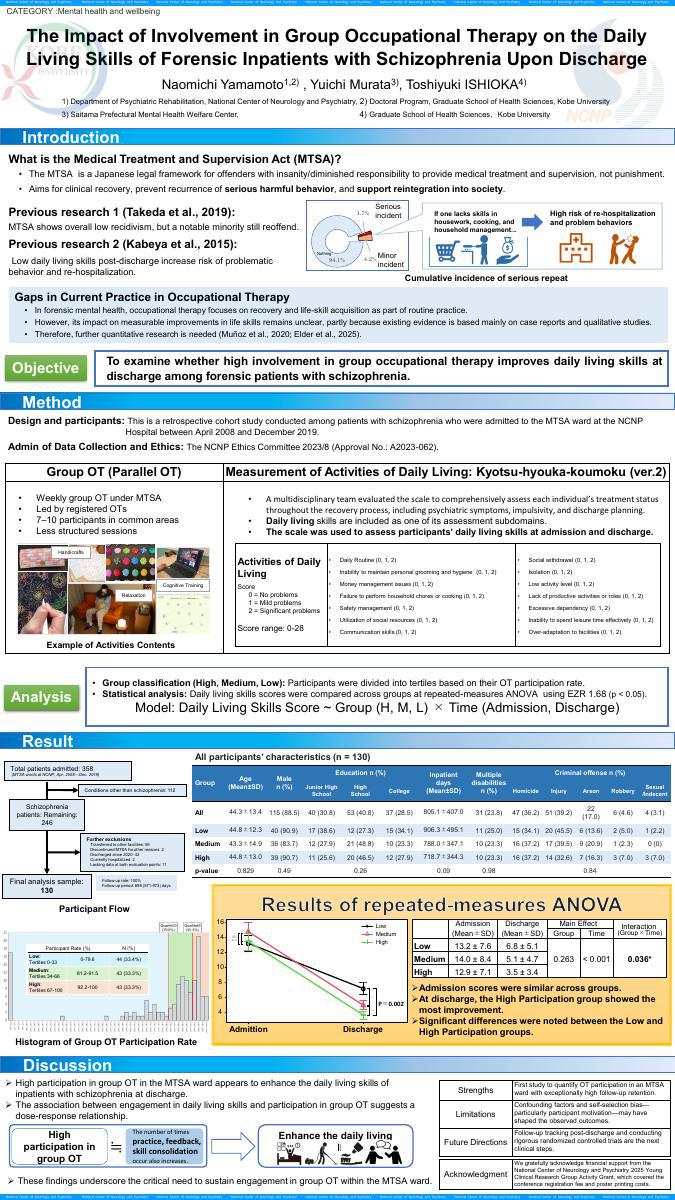
Method: The cohort included forensic schizophrenia patients admitted from April 2008 to December 2019, using medical records data. We gathered their daily living skills at admission and discharge using Kyotsu-hyouka-koumoku (ver.2) and their demographic and medical information. The attendance ratio to total sessions calculated the group OT participation rate. Participants were classified based on OT participation tertiles. Daily living skills scores were compared using repeated ANOVA. Statistical analysis was conducted using EZR 1.68 (p < 0.05). The NCNP Ethics Committee approved the study (Approval No.: A2023-062).
Result: The number of participants was 130. The median participation rate for group OT was 87.2%. Participants were categorized according to group OT participation tertiles: low group (0–33%), middle group (34–66%), and high group (67–100%), with counts of 44, 43, and 43, respectively. Demographic and medical data among these groups were comparable (all ps > 0.05). Repeated ANOVA showed a significant interaction (assessment time x three groups) (p = 0.04). Post hoc analysis indicated that daily living skills scores at discharge improved more in the high group than in the low group.
Conclusion: Group OT enhances daily living skills for forensic patients with schizophrenia post-discharge, highlighting the need for ongoing support.
