
Introduction: Ensuring housing accessibility is essential for older adults to continue living in familiar environments. The Housing Enabler (HE) is a tool to assess housing accessibility including a scoring system that quantifies the severity of potential accessibility problems. A Japanese version of the tool (JHE) has been established.
Objectives: To test the consistency reliability of the scoring points of the JHE.
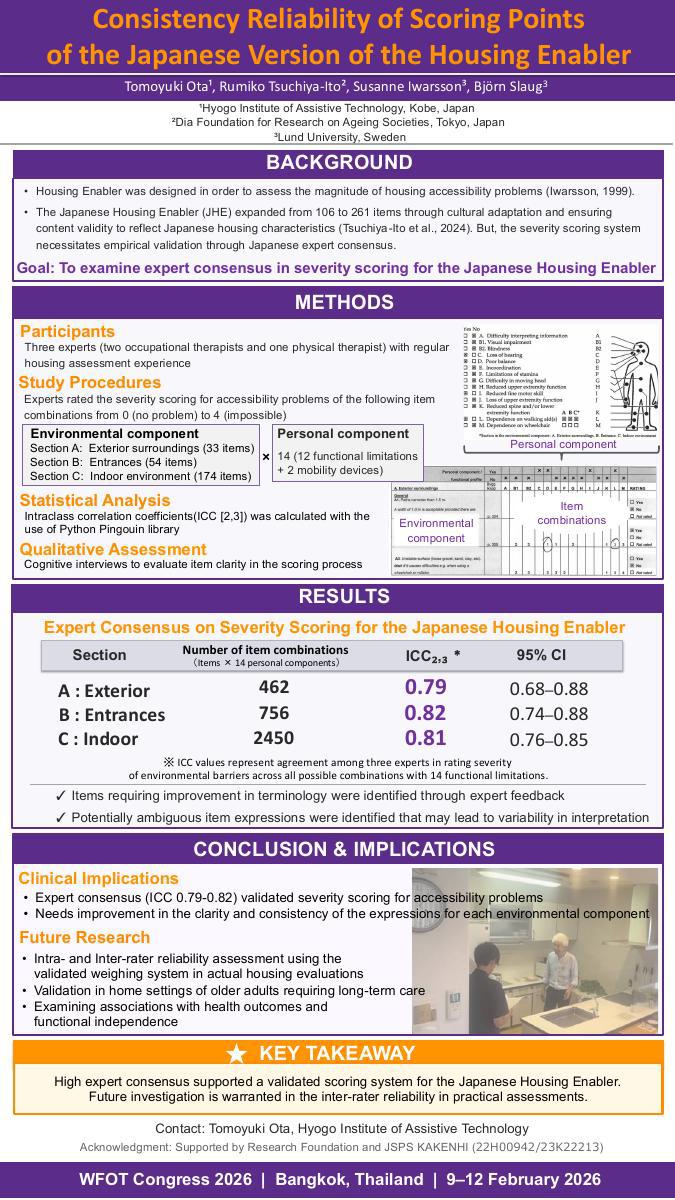
Methods: Using the principles of the of the original HE, accessibility problem scores generated by combing dichotomously scored items of a personal component (14 functional limitations and dependence on mobility devices) with those of an environmental component (environmental barriers across three sections: Section A (exterior surroundings, 33 items), B (entrances, 54 items), and C (indoor environment, 174 items) were rated on a scale from 0(=no problem) to 4(=impossible). In this study, three experts (two occupational therapists, one physiotherapist) who regularly assess housing environments participated and rated based on their clinical experience. The intraclass correlation coefficient (ICC2,3) was used to analyze the degree of consistency in scoring among experts. Additionally, a cognitive interview was conducted, assessing item clarity and ease of response.
Results: ICC analysis showed high levels of agreement among experts: Section A (ICC2,3 = 0.79, 95% CI: 0.68-0.88), B (ICC2,3 = 0.82, 95% CI: 0.74-0.88), and C (ICC2,3 = 0.81, 95% CI: 0.76-0.85). Expert feedback identified some risks of inconsistent scoring, leading to terminology refinement.
Conclusion: The consistency reliability of expert scoring points was supported. Future research should validate these scores through practical applications that involve various raters.