
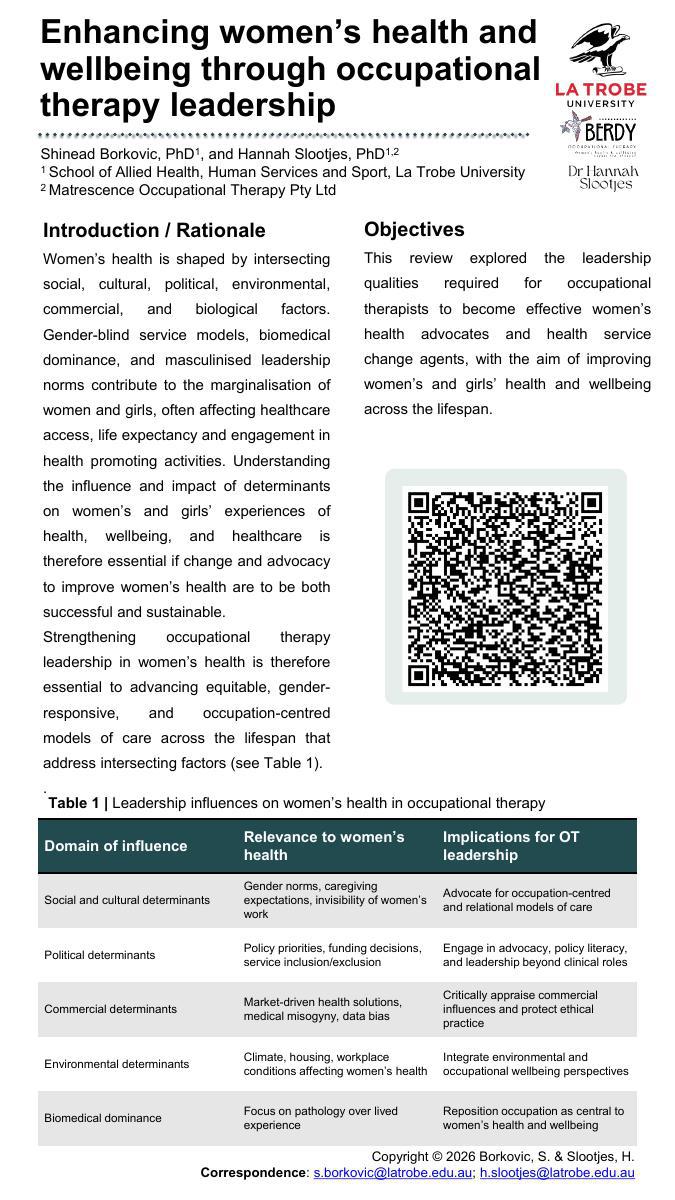
Introduction/ rationale | Leadership in women's health is shaped by a range of social, cultural, political and other systemic factors. Occupational therapists working in this field must navigate these influences whilst striving to establish their roles as integral contributors to women’s health. However, in competitive health and wellbeing sectors, occupational therapists often struggle to be recognised and valued as leaders.
Objectives | This study explored the leadership qualities required for occupational therapists to become a women’s health advocate and health services change agent, in aim of improving women and girls’ health across the lifespan.
Method/ approach | A review of feminist theories was completed to analyse how gender impacts women’s health, and what leadership qualities are required for occupational therapists to visibly and effectively address influencing factors on equitable health services.
Results/ practice implications | The exploration of leadership highlights the pressing need for occupational therapists to assert their expertise and added value in shaping women’s health policies and services. To advance the profession’s profile and integrate this ethos within service design, practitioners need to critically reflect on the transition from practitioner to leader to challenge systemic barriers, redefine their role in interdisciplinary teams, and contribute to more equitable and gender-responsive models of care.
Conclusion / Contribution to the occupational therapy profession: Strengthening the professions’ leadership presence is fundamental for positioning practitioners to drive systemic transformation that responsively supports the unique needs of women around the world, and provides gender-responsive health services. Introduction/ rationale | Leadership in women's health is shaped by a range of social, cultural, political and other systemic factors. Occupational therapists working in this field must