
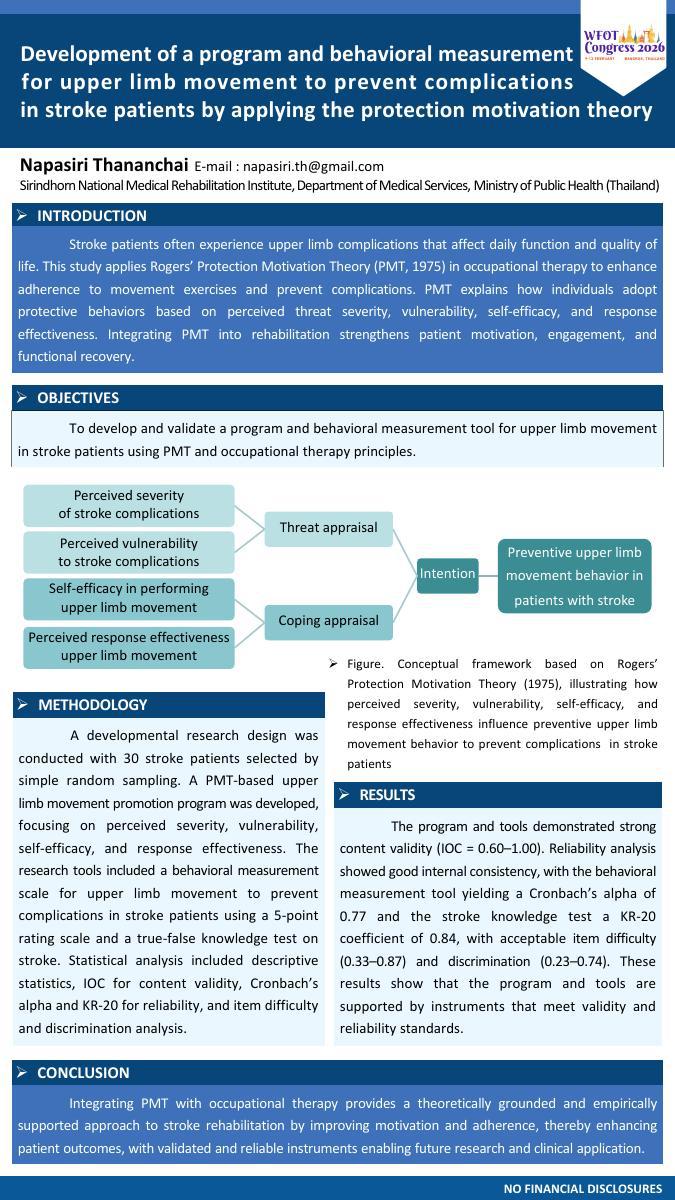
Introduction / Rationale: Stroke patients often experience upper limb complications that affect daily function and quality of life. This study applies Protection Motivation Theory (PMT) in occupational therapy to enhance adherence to movement exercises and prevent complications. PMT explains how individuals adopt protective behaviors based on perceived threat severity, vulnerability, self-efficacy, and response effectiveness. Integrating PMT into rehabilitation strengthens patient motivation, engagement, and functional recovery.
Objectives: To develop and validate a program and behavioral measurement tool for upper limb movement in stroke patients using PMT and occupational therapy principles.
Methods / Approach: A developmental research design was used with 30 stroke patients selected via simple random sampling. The program incorporated PMT principles, focusing on perceived severity, vulnerability, self-efficacy, and response effectiveness. The research tools included a behavioral measurement scale for upper limb movement to prevent complications in stroke patients using a 5-point rating scale and a true-false knowledge test on stroke. Statistical analysis included descriptive statistics, validity, and reliability analysis.
Results / Practice Implications: The program and tools showed strong content validity (0.67–1.00). Reliability analysis indicated good internal consistency, with the behavioral measurement tool achieving a Cronbach’s alpha of 0.77 and the stroke knowledge test a KR-20 reliability coefficient of 0.84. Findings suggest the PMT-based intervention enhances exercise adherence and prevents complications.
Conclusion / Significance to the Occupational Therapy Profession: Integrating PMT with occupational therapy enhances stroke rehabilitation by improving motivation and adherence, supporting better patient outcomes and care.