
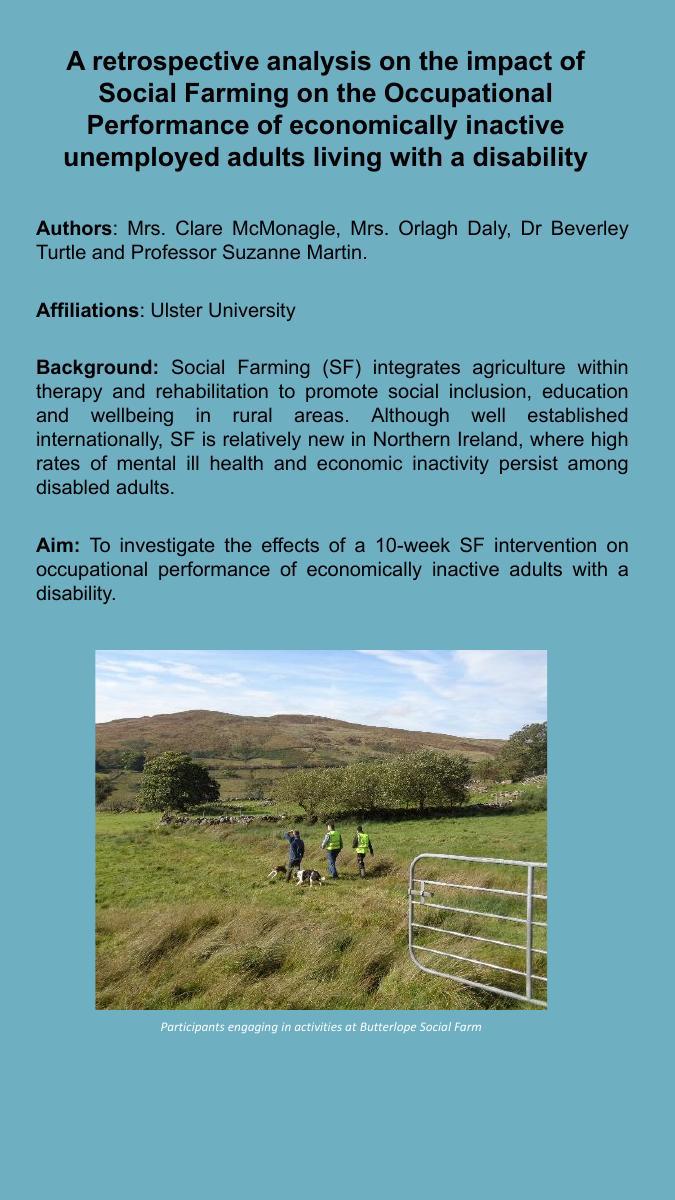
Introduction: Northern Ireland is culturally and politically challenged within the United Kingdom jurisdiction, whilst on the Island of Ireland. Primarily a rural society, political conflict and societal violence has left legacies of high rates of mental ill health and intergenerational economic inactivity. Social Farming embeds agriculture within therapy and rehabilitation to promote social inclusion, education and social services in rural areas.
Objectives: To investigate the impact on function of a 10-week social farming (e.g. animal care, horticulture) intervention on people living with mental ill health who are economically inactive.
Methods: The intervention was delivered over two farm sites by an occupational therapist, an educator and a farmer. Two cohorts of 8 were included at each site, with a final recruitment of 32 participants. A retrospective data analysis of pre- and post-intervention data (qualitative and quantitative) gathered via the Model of Human Occupation Screening Tool on weeks 2 and 10 of participant attendance was completed. Ulster University Ethics committee reviewed and awarded approval (FCNUR-23-075).
Results: Two participants withdrew, leaving 30 participants, predominantly male (n=21), aged between 16 and 70 completing the programme. 19 participants achieved one unit in an accredited land-based activity, with 7 participants attaining a full level 2 certificate. Three participants gained paid employment, and significant positive differences were found between pre- and post-test scores across all domains of the MOHOST.
Conclusion: This study proposes social farming as an effective, meaningful, and person-centred occupational therapy intervention for those living with mental ill health who are economically inactive.